Overview

This section highlights the core features, use cases, and supporting notes.

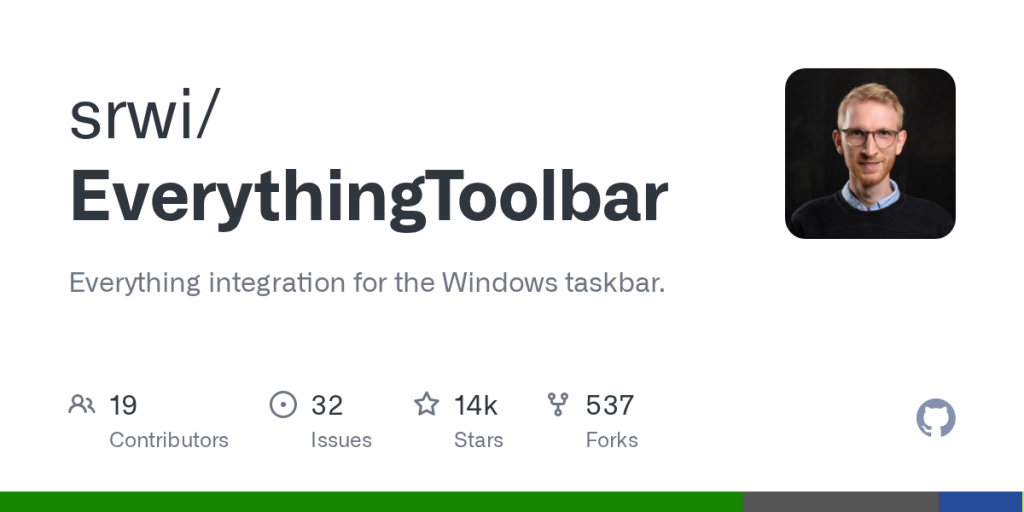
EverythingToolbar is one of the most sensible add-ons for Windows users who already depend on Everything and want its file search power closer to the taskbar instead of buried in a separate app window. The official README, FAQ, and GitHub release trail checked on April 17, 2026 describe a project that is much more specific than a generic launcher. EverythingToolbar is a dedicated taskbar search interface powered by Everything, with theme-aware Windows integration, filter synchronization, quick search flags, regex-based custom actions, keyboard-driven result handling, QuickLook and Seer preview support, and separate launcher and deskband workflows depending on the Windows version. What keeps it worth installing is that the project is unusually honest about its boundaries. It requires Everything 1.4.1 or newer to be installed and running, does not support Everything Lite, explains that native Windows 11 removed deskband support, and points users toward the launcher mode or tools such as ExplorerPatcher and StartAllBack when they specifically want the full deskband experience back. The latest official release page also showed version 2.3.0 published on March 13, 2026, adding a file preview side pane, better start menu forwarding, improved file icon loading, and small search-window refinements. That makes EverythingToolbar strongest for Windows users who already trust Everything and want a faster, more integrated taskbar search surface. It is a weaker fit for anyone who expects a self-contained search engine, does not want Everything running in the background, or wants native Windows 11 deskband behavior without third-party taskbar restoration tools.

The current English page for EverythingToolbar is still too thin for what the official project materials now show. The main README checked on April 17, 2026 defines the product very clearly: it is instant file search integration for the Windows taskbar powered by Everything. That matters because EverythingToolbar is not supposed to replace Everything’s indexing engine. It is supposed to make that engine easier to reach from the Windows taskbar.

Annotated reference image based on the official EverythingToolbar README highlighting its role as a Windows taskbar interface powered by Everything
The overview matters because EverythingToolbar should be judged as a taskbar interface for Everything, not as a separate search engine.

The visual integration is also part of why the tool is worth considering at all. The official README says EverythingToolbar blends into both Windows 10 and Windows 11 and automatically adjusts to the current light or dark system theme. That does not sound dramatic, but for a taskbar utility it matters a lot. If the search surface feels visually foreign, users tend to abandon it even if the search results are fast.

Annotated reference image based on the official EverythingToolbar README highlighting native-looking light and dark theme behavior
The theme support matters because taskbar software has to feel livable over time, not just technically functional.

EverythingToolbar becomes much more persuasive once you look at how it handles filters. The README says it ships with common search filters out of the box, while advanced users can synchronize with Everything’s own custom filters. The FAQ goes further and explains that when Use Everything filters is enabled, filter order follows Everything’s filter order in real time. That makes the toolbar far more useful for people who have already invested effort into organizing their search logic inside Everything.

Annotated reference image based on the official README and FAQ highlighting built-in filters and synchronization with Everything custom filters
The filter integration matters because EverythingToolbar is strongest when it can inherit the search structure users already depend on in Everything.

The quick-search controls show the same practical design. The official README highlights toggles for match case, whole word, match path, and regex. Those are the kinds of controls that keep a taskbar search box useful after the novelty wears off. Instead of forcing users to open a larger app window whenever a query needs precision, EverythingToolbar lets the taskbar surface stay capable enough for real file-search work.

Annotated reference image based on the official README highlighting match case whole word match path and regex controls
The quick-search flags matter because a tiny taskbar search surface still needs real precision controls to stay useful.

The custom action system is another reason the project feels more serious than a simple shell around search results. The README says users can create custom Open with actions under Settings and make them run automatically based on file type conditions and regular expressions. That means EverythingToolbar is not only about finding a file. It can also help route repeat file types into the tools or commands a user already prefers.

Annotated reference image based on the official README showing regex-based custom actions and automatic rule application
The custom-actions feature matters because search results become much more valuable when they can feed repeatable follow-up actions.

The official compatibility notes are where the project’s real operating-system boundary becomes obvious. The README says EverythingToolbar works on Windows 10 and Windows 11, but it also explains that full deskband support on Windows 11 depends on tools like ExplorerPatcher and StartAllBack. That is an important distinction. Without it, users can mistake a Microsoft taskbar limitation for an EverythingToolbar failure.

Annotated reference image based on the official README highlighting Windows 10 and Windows 11 support together with ExplorerPatcher and StartAllBack deskband compatibility
The compatibility notes matter because native Windows 11 taskbar rules are part of the product boundary, not a bug that the project can simply ignore.

The keyboard support is strong enough to justify using a second search surface instead of only switching back to the full Everything window. The official shortcut table documents opening files and containing folders, jumping directly into Everything, copying full paths, previewing with Space, cycling filters with Tab, and focusing the search box with a customizable Win+Alt+S global shortcut. That gives the app a real keyboard-first story instead of a shallow point-and-click shell.

Annotated reference image based on the official shortcut table highlighting result navigation preview and the Win+Alt+S global shortcut
The shortcut table matters because keyboard speed is one of the clearest reasons to keep EverythingToolbar pinned in the first place.

The installation section also deserves more attention than a normal download page. The official README lists Windows 10 or Windows 11 plus Everything 1.4.1 or newer as prerequisites, and it explicitly says the Lite version of Everything is not supported. It then gives two direct install paths: official GitHub Releases and winget commands. That is a clean enough setup path, but only if users understand that Everything itself must already be present and running.

Annotated reference image based on the official installation section showing prerequisites supported Everything versions and release or winget install paths
The install guidance matters because EverythingToolbar depends on a supported Everything instance and should not be treated like a self-contained search app.

The FAQ is especially useful because it turns the most common confusion into plain guidance. It says the launcher is the recommended path for unmodified Windows 11 installations, while the deskband remains the more natural fit for Windows 10 or Windows 11 systems already using ExplorerPatcher or StartAllBack. The same FAQ also says that if no results appear, the first things to check are whether Everything is actually running, whether the Lite build was installed by mistake, and whether Everything 1.5 alpha users need to set the instance name to 1.5a.

Annotated reference image based on the official FAQ explaining launcher versus deskband setup and no-result troubleshooting
The setup FAQ matters because it aligns user expectations around Windows version, toolbar mode, and the dependency on a live Everything process.

The current release line gives the project more credibility than a dormant taskbar tweak would have. The official latest release page showed EverythingToolbar 2.3.0 published on March 13, 2026. The release notes say this update added a file preview side pane with file icon or image preview, file details, and quick actions, while also improving start menu integration, file icon loading, and search-window arrangement to feel a bit closer to Windows 11’s native search. That is exactly the kind of recent maintenance signal a Windows shell-integration tool needs.

Annotated reference image based on the official 2.3.0 release notes highlighting the preview side pane and recent Windows integration improvements
The release trail matters because recent maintenance is one of the strongest reasons to trust a Windows taskbar integration utility.

Our grounded judgment is that EverythingToolbar is most worth keeping for users who already rely on Everything, search for files constantly, and want taskbar-level access with filters, shortcuts, and launcher behavior that fits Windows more naturally. It is less convincing for people who want a standalone search tool, do not want Everything running in the background, or are unwilling to accept the difference between native Windows 11 launcher behavior and restored deskband behavior. EverythingToolbar is a good recommendation when those boundaries are understood in advance.


Setup / Usage Guide

Installation steps, usage guidance, and common notes are maintained here.

The smoothest way to set up EverythingToolbar is to treat it as a taskbar interface for an existing Everything workflow instead of as a brand-new search engine. The official README, FAQ, and release page checked on April 17, 2026 show that the best first run comes from installing the correct Everything build first, choosing the right variant for your Windows version, and then testing search, filters, and shortcuts with realistic file queries right away.

  1. Start from the official project page at https://github.com/srwi/EverythingToolbar so the installation path, FAQ, and release notes all come from the same first-party source chain.
  2. Install the regular Everything application first if it is not already on the PC. EverythingToolbar depends on Everything's SDK and cannot search for files on its own.
  3. Make sure the Everything build is suitable. The official README says Everything 1.4.1 or newer is required, and the Lite version is not supported.
  4. Before installing EverythingToolbar, decide which interface mode matches the machine. On an unmodified Windows 11 system, the launcher is the correct default. On Windows 10, or on Windows 11 systems already using ExplorerPatcher or StartAllBack, the deskband mode is usually the more natural fit.
  5. Download the current installer from the official GitHub release page. When checked on April 17, 2026, the latest release was 2.3.0 published on March 13, 2026, with separate x64 and arm64 installers plus SHA256 files.
  6. Run the installer and keep Everything running in the background. If you close Everything entirely, EverythingToolbar will have no search results to display.
  7. On Windows 11, let the setup assistant guide the launcher configuration. If the assistant does not start automatically, launch EverythingToolbar from the Start menu manually. On Windows 10, enable the deskband from the taskbar's Toolbars context menu and unlock the taskbar if you need to resize or reposition it.
  8. If you use Everything 1.5 alpha, open Settings -> Advanced -> Everything instance name and change the instance name to 1.5a. The FAQ says this is necessary for that alpha branch.
  9. Configure filters early. If you already use custom filters in Everything, enable Use Everything filters so the toolbar can mirror them instead of forcing you to recreate the same structure twice.
  10. Test one precise search with match case, whole word, match path, or regex enabled. This quickly shows whether the taskbar UI is still powerful enough for the kinds of file lookups you actually perform.
  11. Learn the two or three shortcuts that matter most to you. In practice, the result navigation keys, Ctrl+Enter for the containing folder, Shift+Enter for opening in Everything, Space for preview, and the customizable global shortcut are the fastest way to decide whether the tool deserves a permanent place on the taskbar.
  12. If search results do not appear, check the dependency chain before reinstalling. The official FAQ says the most common causes are that Everything is not really running, Everything Lite was installed by mistake, or the 1.5 alpha instance name was left at the default value.
  13. After the basics work, explore optional integrations like QuickLook or Seer preview and custom regex-based actions only if they match your real workflow. They are valuable, but the tool is already worth keeping if the search and shortcut flow is strong.

A practical EverythingToolbar setup usually means confirming the correct Everything build first, picking the right launcher or deskband path for the Windows version, verifying that search results appear immediately, and then layering in filters, shortcuts, and optional preview or action features only where they save time. That order gives the project the fairest evaluation and avoids most first-run confusion.

Related Software

Keep exploring similar software and related tools.