Overview

This section highlights the core features, use cases, and supporting notes.

Frase is better understood as an SEO plus GEO content operations platform than as a simple AI article writer. It is built for teams that need research, optimization, AI-search tracking, publishing connections, and scalable content workflows in one place instead of a pile of disconnected tools. Frase's official homepage, AI Agent page, AI Search Tracking page, SEO plus GEO optimization page, SEO Research page, SEO Content Optimization page, Programmatic SEO page, Integrations page, Pricing page, and Privacy Policy checked on April 18, 2026 show a product aimed at search-content teams rather than casual prompt users. The official site frames Frase around ranking on Google and getting cited by AI, while its feature pages make visible research automation, AI visibility monitoring across ChatGPT and Perplexity, dual SEO and GEO scoring, long-tail page generation, and CMS integrations for publishing. What keeps Frase worth considering is that the workflow is broader than writing alone. The platform promises market research, SERP analysis, content optimization, AI visibility tracking, publishing integrations, and an AI Agent that can work across these jobs. That makes it more useful for content marketers, SEO teams, agencies, and operations-minded teams than for someone who only wants a quick paragraph generator. The pricing page also matters because Frase is clearly sold as a platform, and the privacy page matters because research, drafts, and strategy work often include business-sensitive information. That makes Frase strongest for teams that actively publish search-oriented content and now also care about AI citation and visibility. It is a weaker fit for users who only need a lightweight personal writing helper, do not work in SEO or content operations, or expect a classic desktop app instead of a web platform with recurring workflow depth.

The current English page for Frase is still too thin for what Frase’s own materials now show. The official homepage checked on April 18, 2026 does not present Frase as a simple AI writer. It calls the product The Agentic SEO & GEO Platform and says it helps teams rank on Google and get cited by AI. Its description says Frase researches the market, creates optimized content, and tracks visibility across Google, ChatGPT, and Perplexity. That positioning matters because Frase is clearly built for ongoing search-content operations, not only for one-off text generation.

Annotated reference image based on the official Frase homepage highlighting agentic SEO GEO positioning and AI citation visibility
The homepage matters because Frase should be judged as a search-content platform rather than as a generic AI writing site.

The official AI Agent page pushes that platform story further. Frase describes the agent as a built-in AI content assistant inside the SEO platform, and the official description says it covers topic clusters, content atomization, programmatic SEO, AI image generation, and brand governance. That is a much broader product surface than a narrow article writer. It suggests Frase is trying to act like an operating layer for content teams rather than a single generation tool.

Annotated reference image based on the official Frase AI Agent page highlighting built-in research writing and optimization workflows
The AI Agent page matters because Frase is trying to unify several content operations jobs inside one platform surface.

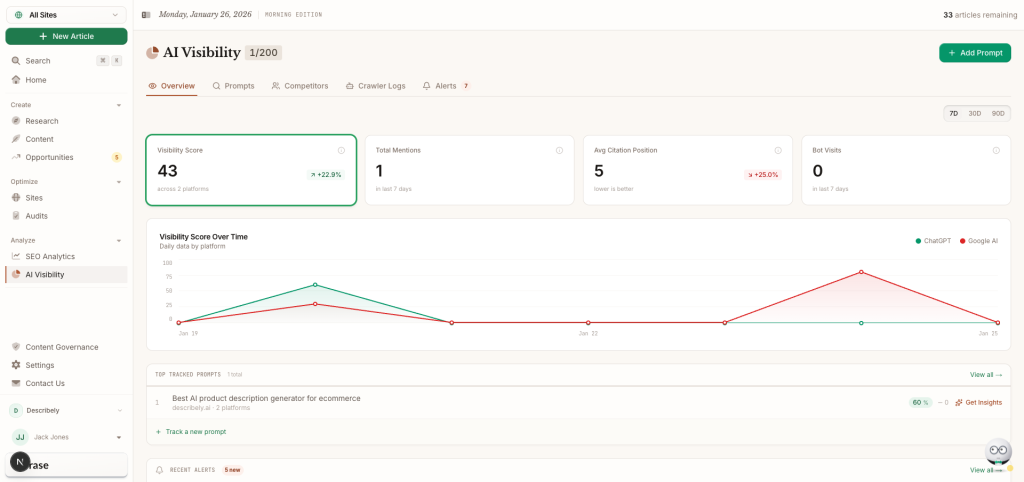
The AI Search Tracking page is one of the clearest modern differentiators. Frase says it can monitor brand visibility across ChatGPT, Claude, Gemini, Perplexity, and more with daily updates. The page also states that millions of people ask these systems for product recommendations every day. That matters because AI answer engines create a new visibility problem that classic rank tracking does not fully cover.

Annotated reference image based on the official Frase AI Search Tracking page highlighting monitoring across ChatGPT Claude Gemini and Perplexity
The AI Search Tracking page matters because Frase is solving monitoring for AI answer platforms, not only traditional search positions.

The SEO + GEO Optimization page makes Frase’s core bet even clearer. The page says each piece of content now has two audiences: traditional search engines and AI platforms. Frase describes this as dual SEO and GEO scoring with real-time optimization for Google and AI systems. That is important because it shows the platform is deliberately built around the newer content environment where ranking and citation need to be handled together instead of separately.

Annotated reference image based on the official Frase SEO and GEO optimization page highlighting dual optimization for Google and AI platforms
The SEO plus GEO page matters because Frase is explicitly built around dual optimization instead of old single-channel SEO alone.

The official SEO Research page covers another pain point content teams know well: early-stage analysis. Frase says it can cut SEO research from four hours to five minutes with instant SERP analysis, competitor keywords, and content gaps. The visible text says it is for teams that need quick wins instead of overwhelming data. That matters because research time often delays content production long before anyone writes a draft.

Annotated reference image based on the official Frase SEO research page highlighting fast SERP analysis and content gap discovery
The research page matters because time saved before writing often decides whether an SEO platform feels practical at all.

The SEO Content Optimization page shows how Frase wants to connect research back into writing. The official description says users can research, write, and optimize in one workflow, and the visible page text says Frase analyzes what top-ranking content covers and then helps create something better. That matters because modern optimization is more credible when it is tied to competitive coverage and live workflow rather than to isolated keyword density suggestions.

Annotated reference image based on the official Frase content optimization page highlighting research write and optimize in one workflow
The content optimization page matters because Frase is strongest when research and writing are tied directly to ranking improvement.

The Programmatic SEO page broadens the scope again. Frase says it can generate hundreds of SEO-optimized pages at scale for location, comparison, and integration content, with batch generation and one-click publishing. That matters because some teams do not only need better individual articles. They need repeatable long-tail page production that can be managed with more structure and less manual repetition.

Annotated reference image based on the official Frase programmatic SEO page highlighting scaled page generation and one-click publishing
The programmatic page matters because Frase is trying to serve scaled SEO operations, not only editorial one-offs.

The official Integrations page is another practical signal. Frase says users can publish to WordPress, Webflow, and Sanity, import from Notion and URLs, and connect to Google Search Console, Slack, and thousands of apps through Zapier. That matters because serious content operations rarely live inside one tool alone. Frase becomes much more useful if it connects to the stack teams already use.

Annotated reference image based on the official Frase integrations page highlighting WordPress Webflow Sanity and other workflow connections
The integrations page matters because Frase becomes far more practical when it connects to the rest of the team’s stack.

The Pricing page helps set expectations honestly. Frase says every plan includes the complete agent with research, optimization, AI visibility, site audits, publishing, and API, and the page states plans start from $39/mo with a 7-day free trial. That is useful context because Frase is not trying to be a tiny free helper. It is being sold as a full platform, and users need to decide whether that depth is justified by their workflow.

Annotated reference image based on the official Frase pricing page highlighting full platform scope and starting plan details
The pricing page matters because Frase is selling a platform-wide workflow and users need that scope to be visible up front.

The Privacy Policy matters for the same reason. Frase’s official privacy page says it covers data collection, retention, security, and user rights, and the visible text shows the policy was last updated in January 2025. That is important because search research, draft content, and publishing plans can all contain business-sensitive material. Trust and data handling are part of whether Frase deserves real production use.

Annotated reference image based on the official Frase privacy page highlighting privacy rights data retention and security language
The privacy page matters because teams need a visible data-handling policy before putting real content operations work into Frase.

Our grounded judgment is that Frase is most worth keeping for content marketers, SEO teams, agencies, and operations-heavy teams that actively care about research speed, search optimization, AI visibility, and scalable publishing workflows. It is less compelling for users who only need a simple personal writing helper or who do not work in search-content environments. Frase stays useful when the task is managing and improving search-facing content operations, not just generating paragraphs.

Setup / Usage Guide

Installation steps, usage guidance, and common notes are maintained here.

The best way to start with Frase is to treat it as a web platform for search-content operations rather than as a stand-alone AI writer. Frase's official product pages checked on April 18, 2026 show that the smoothest first run comes from understanding the platform scope, testing one real research-to-optimization workflow, and only then deciding whether the wider agent, tracking, and scaling features justify a longer-term place in your process.

  1. Start from the official homepage at https://www.frase.io/. That gives you the clearest overview of the platform, its SEO plus GEO positioning, and the free-trial path.
  2. Read the official Pricing page early. Frase is sold as a platform, not a tiny utility, so it is better to understand plan scope, trial expectations, and whether the workflow depth matches your team before building habits around it.
  3. If your team is evaluating Frase seriously, start with one real topic or page you already care about instead of a fake test keyword. Frase's value shows up best when it is working on a genuine content opportunity.
  4. Open the SEO Research feature first and inspect how Frase handles SERP analysis, competitor coverage, and content gaps. This is the quickest way to tell whether the platform saves meaningful research time.
  5. After research, move into SEO Content Optimization with one concrete draft or page outline. Frase's workflow makes the most sense when research and optimization are connected directly instead of being tested as unrelated features.
  6. If AI answer engines matter for your brand or clients, review the official AI Search Tracking and SEO + GEO Optimization pages next. These features are part of what separates Frase from older SEO-only tools.
  7. Only after the basic research-and-optimization path feels useful should you explore the broader AI Agent. The agent is easier to judge once you already understand the simpler platform jobs it is supposed to accelerate.
  8. If your work includes large-scale location, comparison, or integration pages, test the Programmatic SEO workflow on one small controlled batch instead of rolling it out everywhere at once. This helps you check quality before volume becomes the main story.
  9. Review the Integrations page before trying to fit Frase into your stack. The platform is much easier to keep if it connects cleanly to the CMS, docs, and reporting tools your team already uses.
  10. If Frase will touch client work, internal strategy, or unpublished content, read the official Privacy Policy early rather than later. Search and content operations often involve sensitive information, and trust should be checked before the workflow becomes routine.
  11. Keep expectations realistic about what Frase is best at. It is stronger for SEO and AI-search content operations than for casual personal writing or offline editing.
  12. Finish the evaluation with one practical question: do you actually need a full research, optimization, and AI-visibility platform, or would a lighter writing tool be enough for your current workflow?

A practical Frase setup usually means starting from the official homepage and pricing page, proving the platform with one real keyword or topic through research and optimization first, then expanding into AI tracking, integrations, and programmatic scaling only where they fit your actual publishing process. That order gives Frase the fairest evaluation and avoids mistaking platform breadth for immediate day-one value.

Related Software

Keep exploring similar software and related tools.