Jenni AI
Category AI Office
Published 2026-04-05

Overview

This section highlights the core features, use cases, and supporting notes.

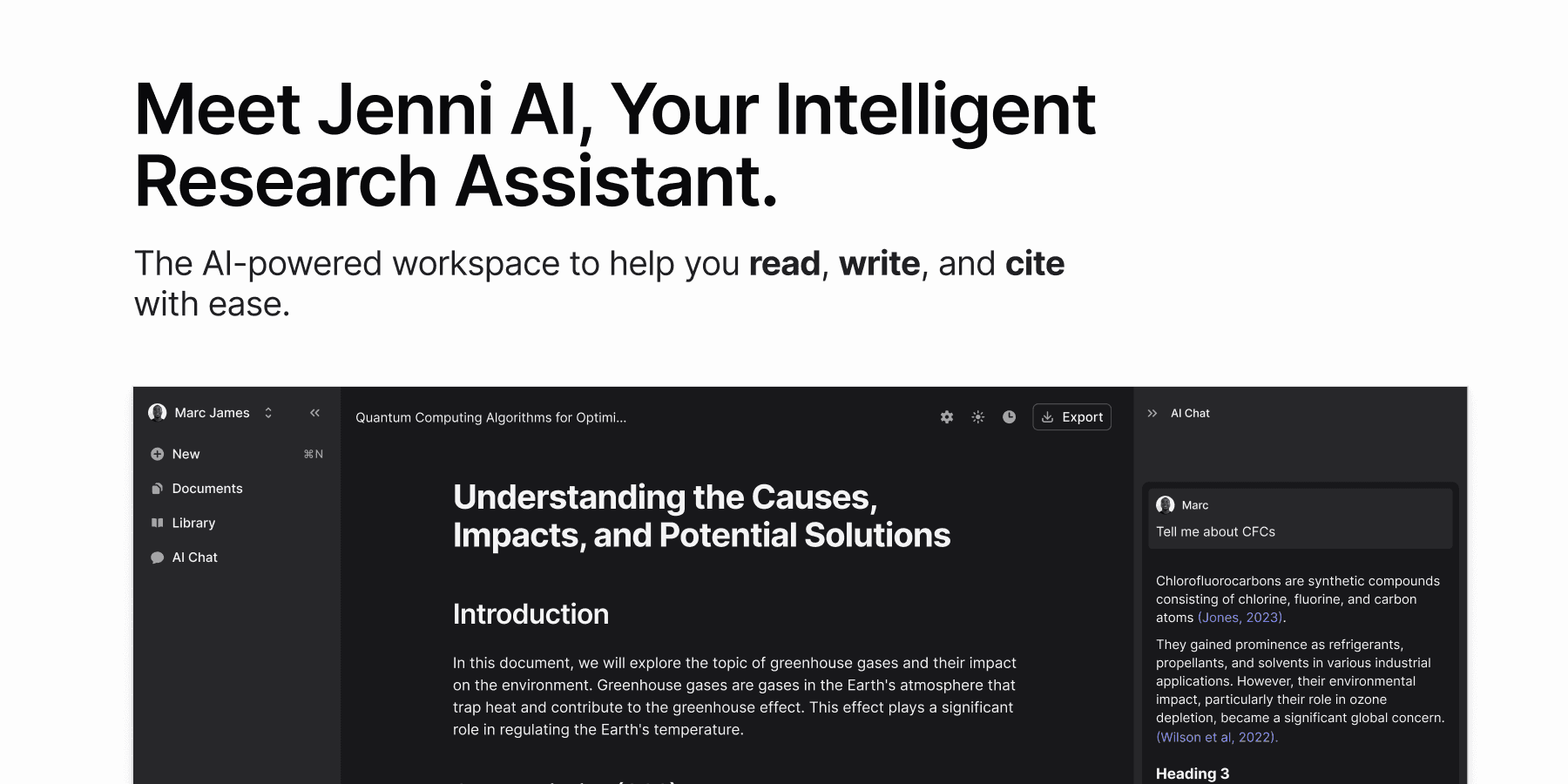
Jenni AI is an academic writing and research workspace built to help users read, write, organize, and continue long-form scholarly work with AI assistance. It is most useful when the challenge is not producing one paragraph, but steadily pushing a paper, review, or research document forward over time.

Jenni AI matters because academic writing often fails in continuity, not in generation. The official platform positions itself as an AI academic writer and research tool that helps students and researchers create papers, essays, and citations while reading, writing, and organizing research in one workspace.

It suits students, researchers, applicants, and scholars working on long-form English writing, literature reviews, and structured academic documents. If your workflow includes sustained drafting and rewriting over many sessions, the product direction is practical.

What makes Jenni AI worth attention is its process orientation. A writing tool becomes far more useful when it helps maintain momentum across a larger document instead of only producing isolated chunks of text.

The tradeoff is that academic fluency is not the same thing as academic rigor. Citations, factual precision, and argument quality still require human oversight. The right expectation is smoother long-form writing support, not automatic scholarly quality.

This site recommends Jenni AI for users who need help sustaining complex research writing rather than only drafting short answers. If long-form academic progress is your real bottleneck, it is worth close attention.


Setup / Usage Guide

Installation steps, usage guidance, and common notes are maintained here.

  1. Open Jenni AI from the official site and start with an actual long-form writing project. The tool makes more sense on a paper, review, or application document than on a short test prompt.
  2. Use it to continue or organize a draft, not only to generate from zero. Process-support tools show their value more clearly in ongoing work.
  3. Review citations and references manually. Academic writing quality depends on source integrity, not just on fluent wording.
  4. Let the tool help you move through sections one by one. Sustained progress is often more valuable than one large generated block.
  5. Use it for outline refinement, phrasing support, and draft continuity where needed. These are often the strongest use cases in long-form academic work.
  6. Check logic transitions and evidence alignment after every major AI-assisted section. Smooth prose can still hide weak reasoning.
  7. Keep your own project structure and notes organized alongside the AI workspace. Good research writing still depends on disciplined inputs.
  8. Keep Jenni AI if it helps you maintain writing momentum and document structure without weakening academic standards. That continuity support is its strongest case.

Related Software

Keep exploring similar software and related tools.