Teamo
Category AI Agents
Published 2026-04-04

Overview

This section highlights the core features, use cases, and supporting notes.

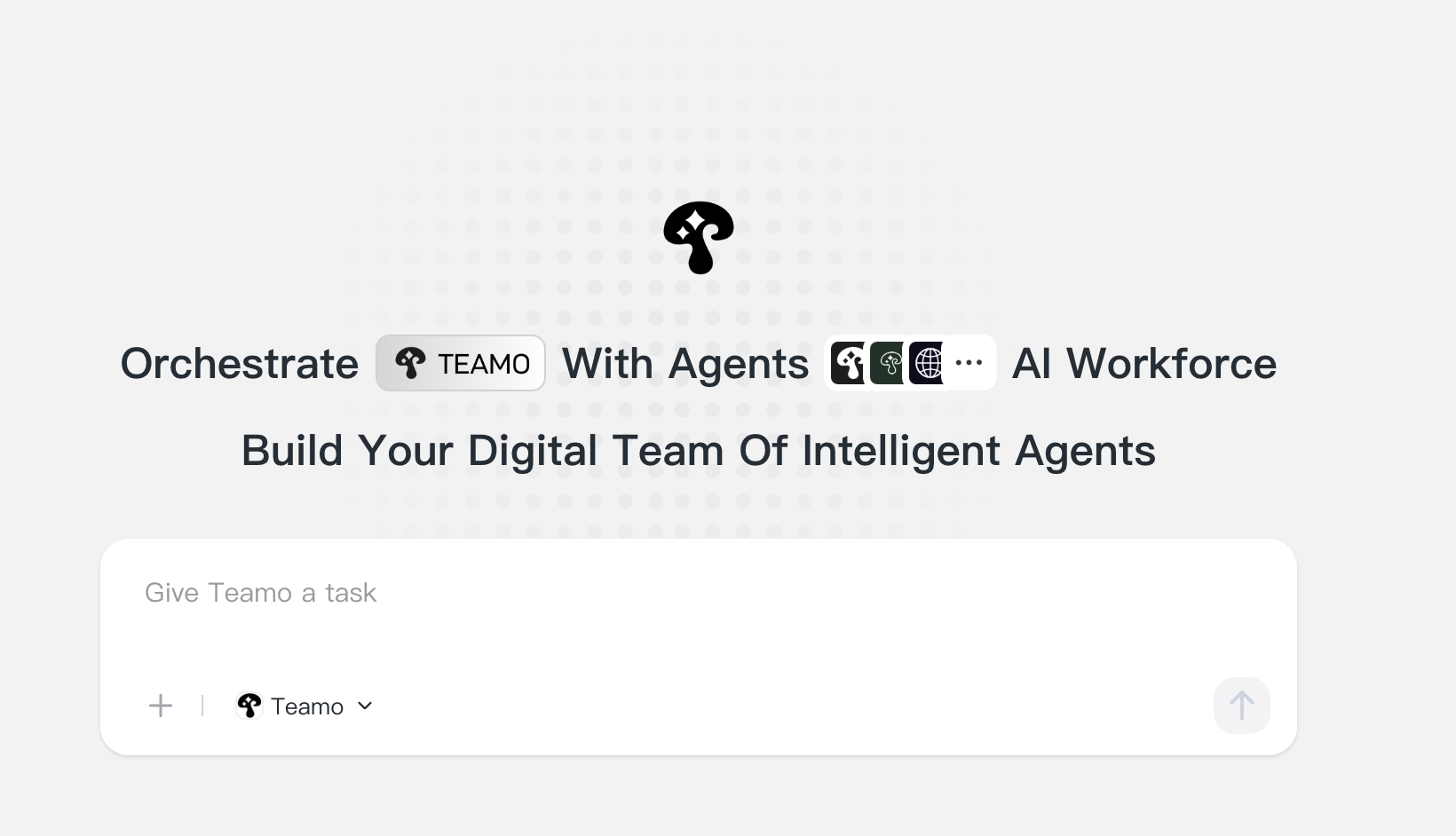
Teamo is a multi-agent productivity platform for knowledge workers who need complex research, strategy, or content tasks broken into coordinated roles instead of handled by one generic assistant. It is most valuable when the work benefits from separate agents for investigation, synthesis, review, and final decision support.

Teamo matters because some knowledge work is messy for a single assistant to handle well. The official product positioning focuses on multi-agent collaboration for complex business scenarios such as marketing, strategy, and research, which tells you immediately that the product is aimed at layered tasks rather than quick replies.

It suits research teams, strategy work, consultants, content planners, and anyone who regularly has to gather information, compare options, check risks, and turn that into a usable conclusion. If the task naturally contains multiple stages or perspectives, Teamo’s model is easier to understand.

What makes it worth attention is structured decomposition. Breaking a difficult task into roles can make the process more inspectable and, in some cases, more controllable than relying on one answer stream to do everything at once.

The tradeoff is that more agents do not automatically mean better outcomes. Weak task definitions, poor evidence, or unnecessary role complexity can make a multi-agent setup slower and noisier instead of clearer. The practical expectation is better organization of complex thinking, not automatic correctness.

This site recommends Teamo for users whose work already resembles team-based reasoning. If one assistant tends to blur research, analysis, and review together, a multi-agent platform is worth trying.


Setup / Usage Guide

Installation steps, usage guidance, and common notes are maintained here.

  1. Open the official Teamo platform and begin with one bounded complex task. Good first examples include market research, strategy comparison, or a multi-part content brief.
  2. Define the final deliverable before you create the agent team. A platform like this works better when the expected output is clear from the start.
  3. Add only the roles that serve a real purpose. A researcher, synthesizer, and reviewer may be enough for many jobs; extra roles can create noise without adding value.
  4. Provide source material or a clear evidence standard early. Multi-agent systems still depend on the quality of the information they are given.
  5. Review intermediate outputs instead of waiting for the final answer only. The value of a collaborative setup is partly in seeing where the thinking goes off track.
  6. Use the final result as a draft for human judgment, not as an automatic business decision. Strategy and research tools still need supervision.
  7. Refine the team structure after one or two real runs. Better decomposition usually comes from practical iteration, not from trying to design the perfect agent org chart upfront.
  8. Keep Teamo if role-based collaboration makes complex work easier to inspect and finish. That is the real advantage of a multi-agent productivity tool.

Related Software

Keep exploring similar software and related tools.