Overview

This section highlights the core features, use cases, and supporting notes.

Writer is most useful when it is judged as an enterprise AI platform for agentic work instead of as a generic AI writing box. The official homepage, Writer Agent page, AI Studio page, graph-based RAG Knowledge Graph page, Palmyra LLM page, trust page, plans page, research page, customer spotlights page, and Writer AI Academy checked on April 18, 2026 all point to a product built for organizations that need governed AI workflows rather than casual one-person prompting. That stack matters because Writer is clearly trying to solve several enterprise problems together. The homepage says Fortune 500 companies use it to execute and scale on-brand compliant work. Writer Agent presents one interface for enterprise work. AI Studio says business teams can build safely with AI-native governance and interoperability. The Knowledge Graph page says Writer's graph-based RAG can achieve higher accuracy than traditional vector-retrieval approaches. What keeps Writer worth considering is that the platform story is broader than a single assistant. Palmyra adds Writer's own model family for mission-critical workflows. The trust page emphasizes security privacy and compliance requirements. The plans page shows a 14-day free trial and sales-led expansion motion. The customer spotlights and academy pages also matter because enterprise adoption usually depends on proof of use and training, not only on product demos. Our grounded judgment is that Writer is strongest for teams and organizations that need AI workflows tied to governance, internal knowledge grounding, shared brand standards, and enterprise rollout. It is a weaker fit for users who only want a cheap personal chatbot, a simple Windows desktop installer, or a lightweight offline writing assistant. Writer looks most defensible when the real problem is not just generating text, but operationalizing AI work safely across a business.

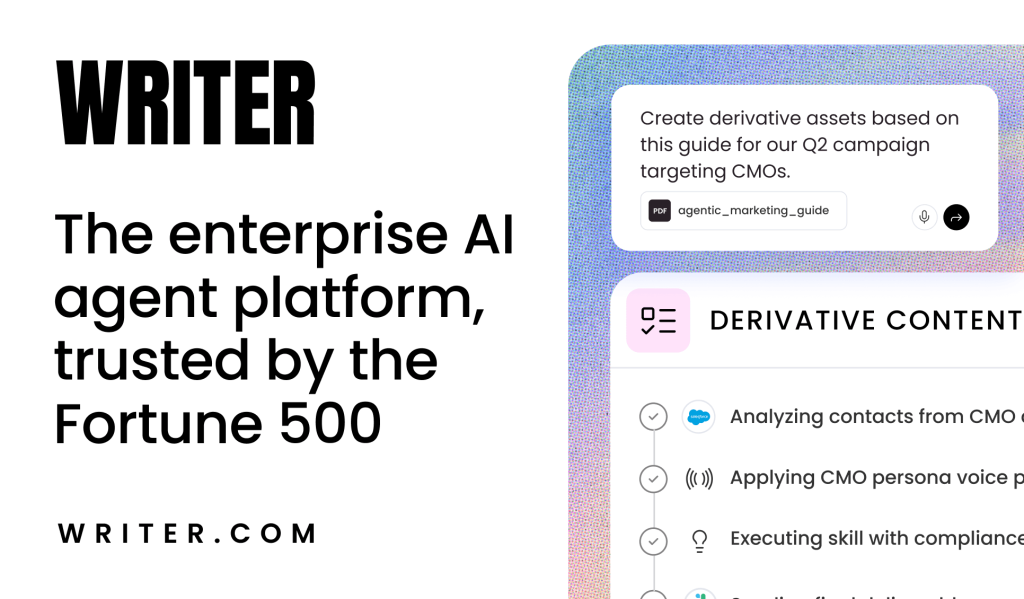
The current English page for Writer is still too thin for what Writer’s own official materials now show. The official homepage checked on April 18, 2026 presents Writer as The enterprise AI platform for agentic work, and its description says Fortune 500 companies use it to execute and scale on-brand, compliant work. That matters because Writer should not be judged like a generic AI writing site. It is trying to be an enterprise execution platform with governance and operational reach.

Annotated reference image based on the official Writer homepage highlighting the enterprise AI platform for agentic work positioning
The homepage matters because it defines Writer as an enterprise execution layer, not just another AI text box.

The official Writer Agent page shows the user-facing center of that platform. Writer describes it as One intelligent interface for enterprise work and says it transforms personal productivity into enterprise-level performance. That matters because enterprise AI platforms only become durable when there is a clear everyday interface through which people can actually use the system instead of only hearing architectural claims from leadership or procurement.

Annotated reference image based on the official Writer Agent page highlighting the single interface for enterprise work
The Writer Agent page matters because it shows how the platform becomes everyday work instead of only backend infrastructure.

The AI Studio page adds another important layer. Writer says business teams can build safely with AI-native governance and interoperability with their stack. That matters because many organizations do not only want a ready-made assistant. They want a controlled way to build internal workflows, tools, or use-case-specific experiences without losing policy control. AI Studio makes Writer look more like a platform for governed internal AI construction than a fixed product with one narrow surface.

Annotated reference image based on the official Writer AI Studio page highlighting safe building governance and interoperability
The AI Studio page matters because it ties practical building work to governance instead of treating them as separate purchases.

The official Knowledge Graph page is one of the clearest signals that Writer cares about enterprise grounding. Its description says Writer’s graph-based RAG achieves higher accuracy than traditional vector-retrieval approaches. That matters because enterprises usually care less about flashy one-shot output and more about whether an AI system can answer against internal knowledge with enough consistency to be trusted in real workflows. Writer is explicitly telling buyers that accuracy and retrieval architecture are part of the product case.

Annotated reference image based on the official Writer Knowledge Graph page highlighting graph based RAG and higher accuracy claims
The Knowledge Graph page matters because enterprise AI usually rises or falls on how well it grounds answers in internal knowledge.

The Palmyra page extends that story downward into the model layer. Writer describes Palmyra as a family of LLMs for mission-critical workflows, engineered for precise and dependable performance. That matters because Writer is not only packaging someone else’s model behind a polished interface. It is trying to present an end-to-end enterprise stack in which the model layer, knowledge layer, governance layer, and user-facing agent layer all live inside one vendor story.

Annotated reference image based on the official Palmyra page highlighting dependable performance for mission critical workflows
The Palmyra page matters because Writer is trying to present an end-to-end enterprise stack rather than a loose integration shell.

The Trust page is equally important because enterprise AI adoption often fails on legal, security, or compliance review before users ever see a polished pilot. Writer says the platform is designed to meet enterprise security, privacy, and compliance requirements. That matters because a platform like Writer only becomes realistic for internal knowledge work or cross-team rollout when the trust surface is visible enough to survive serious review.

Annotated reference image based on the official Writer trust page highlighting security privacy and compliance positioning
The trust page matters because enterprise AI only becomes real once legal security and compliance teams can live with it.

The Plans page shows the commercial motion that sits behind the product. Writer says teams can compare plans, start a 14-day free trial, or contact sales. That matters because evaluation structure often reveals the intended customer much more clearly than homepage slogans. Writer is clearly built for organizational trial, expansion, and procurement rather than for casual software collecting.

Annotated reference image based on the official Writer plans page highlighting the 14 day free trial and organization level rollout path
The plans page matters because enterprise fit is easier to judge when the evaluation and buying path are visible.

The Research page adds another useful signal. Writer says the page explains its approach to advancing AI for the enterprise and points to the four pillars driving its AI solutions. That matters because buyers of enterprise AI infrastructure often want to see that the vendor has a stated technical direction and not only a collection of marketing claims arranged around whatever is selling well this quarter.

Annotated reference image based on the official Writer research page highlighting the enterprise AI approach and four pillars
The research page matters because it adds a visible technical narrative behind the enterprise platform claim.

The Customer spotlights page helps ground the platform in adoption proof. Writer says world-class companies trust it to maximize productivity and creativity across every team. That matters because a platform aimed at enterprise work needs visible evidence that it can extend across functions instead of staying trapped in one pilot group. Even without inventing benchmark claims, this page shows that adoption across teams is part of the product story Writer wants to tell.

Annotated reference image based on the official Writer customer spotlights page highlighting cross team enterprise adoption
The customer spotlights page matters because enterprise tools are easier to recommend when visible adoption is part of the case.

The Writer AI Academy page is smaller but still highly relevant. It positions Writer as a platform with online learning classes, which matters because enterprise AI success is partly a training problem. A governed AI platform can still fail if admins, champions, and daily users do not understand how to adopt it responsibly. The academy surface makes Writer look more serious about operational enablement than a vendor that only hands over an app link and hopes habits appear on their own.

Annotated reference image based on the official Writer AI Academy page highlighting online learning classes for platform adoption
The Academy page matters because enterprise AI deployment is partly a training problem, not only a product problem.

Our grounded judgment is that Writer is strongest for organizations that need AI workflows tied to governance, internal knowledge grounding, shared brand standards, and cross-team rollout. It is a weaker fit for users who only want a cheap personal chatbot, a simple Windows installer, or a lightweight offline writing helper. Writer looks most defensible when the real problem is not merely generating text, but operationalizing AI work safely across a business.

Setup / Usage Guide

Installation steps, usage guidance, and common notes are maintained here.

The best way to start with Writer is to treat it as a browser-based enterprise AI platform rather than as a normal downloadable Windows utility. Writer's official pages checked on April 18, 2026 show a stack built around agentic work, governed building, grounded enterprise knowledge, internal model control, trust review, organizational rollout, and training.

  1. Start from the official homepage at https://writer.com/ and confirm that your real need is governed enterprise AI work, not only casual personal prompting.
  2. Open the official Writer Agent page next so you understand the everyday interface Writer expects teams to use for enterprise work.
  3. If your team wants to build internal AI workflows instead of only using a preset assistant, review AI Studio carefully. It is one of the clearest signals that Writer is meant to support controlled internal building.
  4. If your use case depends on company documents, policies, support material, or knowledge bases, study the official Knowledge Graph page. Retrieval and grounding quality usually decide whether enterprise AI can be trusted at scale.
  5. Review the official Palmyra page if model behavior, reliability, and workflow fit matter to your evaluation. Writer is explicitly presenting its own model family as part of the platform.
  6. Read the official Trust page before moving any serious internal material into a pilot. Security, privacy, and compliance review are often the real blockers, not the demo quality.
  7. Use the official Plans page to decide whether the 14-day free trial is enough for your evaluation or whether the workflow already points toward a sales-assisted enterprise rollout.
  8. When you are ready to test the product directly, go to https://app.writer.com/ and enter the official web app. Writer is primarily a browser-based platform rather than a traditional downloadable desktop program.
  9. Do not begin with a giant enterprise rollout. Start one narrow pilot around a real task, such as governed content production, internal knowledge assistance, support drafting, or another repeatable workflow with clear owners.
  10. Assign one person to review governance and one person to review output quality against real business standards. Writer is built for organized use, so the evaluation should also be organized.
  11. Use the official Customer spotlights page to compare your pilot expectations with the kinds of cross-team adoption Writer is publicly trying to support.
  12. Enroll admins or champions in the official Writer AI Academy once the pilot looks promising. Training is one of the most practical ways to prevent a good enterprise platform from becoming a confusing one.
  13. Read the official Research page if your stakeholders need a clearer technical narrative behind Writer's enterprise AI direction.
  14. Finish the evaluation with one practical question: does Writer solve your governance, knowledge-grounding, and rollout needs better than a generic AI tool would, or are you paying for enterprise structure you do not actually need?

A practical Writer setup usually means beginning with the official site, aligning on one governed use case, reviewing trust and knowledge-grounding surfaces early, testing through the official web app, and treating training plus rollout ownership as part of the product decision rather than as chores to postpone until after purchase.

Related Software

Keep exploring similar software and related tools.