
ChatWise
Category AI Chat
Published 2026-04-04

Overview

This section highlights the core features, use cases, and supporting notes.

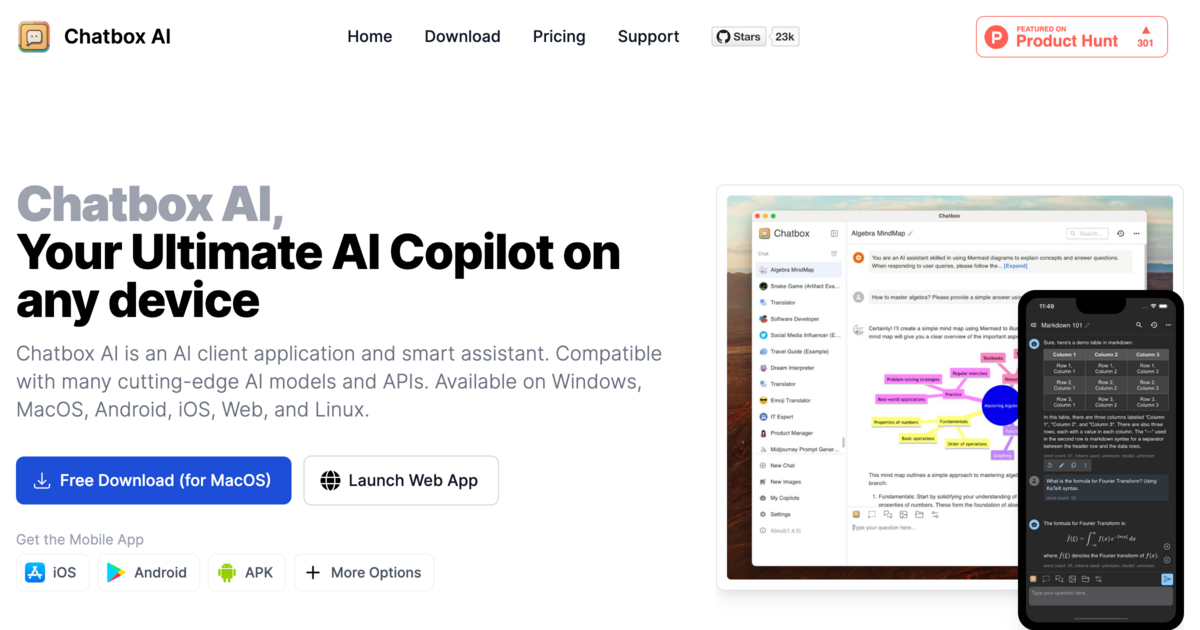
ChatWise is a desktop AI chatbot built for fast multi-model chatting with local data storage, multimodal input, and a privacy-friendly desktop workflow. It is most useful for heavy AI users who want one stable client for ChatGPT, Claude, Gemini, DeepSeek, local files, and ongoing conversations instead of living in many browser tabs.

ChatWise matters because long-term AI use gets messy when every model lives in a separate web page. The official product positioning emphasizes a fast desktop chatbot, support for multiple LLMs, local data storage, multimodal inputs, and a simple but desktop-optimized experience.

It suits researchers, writers, analysts, and heavy chat users who keep switching models, attaching PDFs or images, and returning to prior conversations. If you want a permanent desktop entry point for AI work instead of starting from scratch in the browser each day, the product direction is straightforward.

What makes ChatWise worth attention is the combination of local-first privacy and multi-model convenience. Keeping data on the device, while still connecting to multiple providers, is a more meaningful daily-use feature than one more flashy landing page.

The tradeoff is that a strong client does not eliminate model limitations or data-handling responsibility. Local storage helps, but API credentials, document quality, and output verification still matter. The correct expectation is a better AI workstation, not safer answers by default.

This site recommends ChatWise for users who treat AI chat as a regular working interface rather than a casual novelty. If model switching, local files, and long-running conversation history are part of your workflow, it is worth keeping on the desktop.

Setup / Usage Guide

Installation steps, usage guidance, and common notes are maintained here.

  1. Download ChatWise from the official site and install the desktop client from the official release path. A desktop-first chat tool should always come from the product's own distribution channel.
  2. Set up one or two model providers first instead of connecting everything at once. This makes it easier to compare speed, cost, and answer quality without clutter.
  3. Import a real file or document early. PDF, image, or text-file support is part of the product promise and should be tested with material you actually care about.
  4. Check where conversation history and attachments are stored locally. Privacy-friendly clients are most trustworthy when the storage model is clear.
  5. Use the same question across different models to judge practical switching value. Multi-model support only matters when it changes how you work, not just how many names appear in a menu.
  6. Review the web-search or extended tools only after the core chat flow feels stable. The strongest reason to keep a client like this is daily usability, not feature overload.
  7. Keep sensitive material under the same review standards you would apply anywhere else. Local storage helps, but model outputs still need verification.
  8. Keep ChatWise if it makes multi-model AI work feel more coherent and less tab-heavy. That steady desktop convenience is the real product value.

Related Software

Keep exploring similar software and related tools.