GoCodeo
Category AI Coding
Published 2026-04-05

Overview

This section highlights the core features, use cases, and supporting notes.

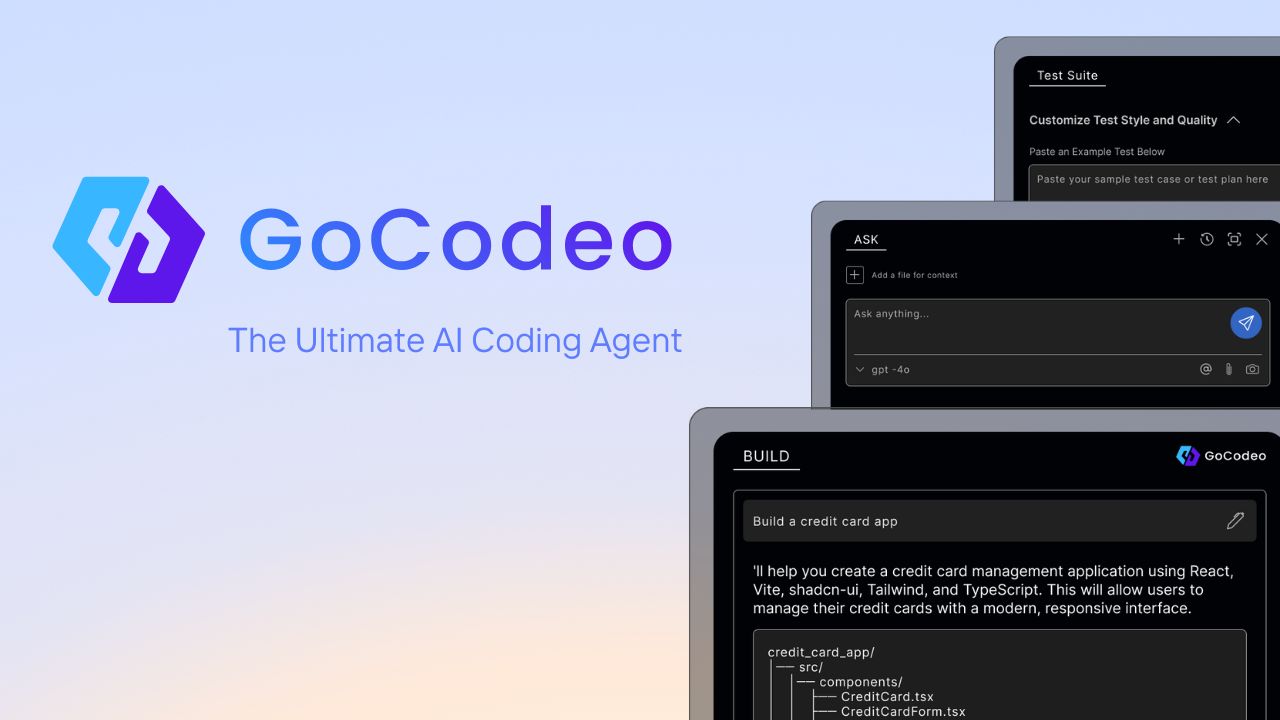
GoCodeo is an AI coding agent for engineers who want code generation, asking, and testing to happen in a more action-oriented development flow. It is most useful when the work involves moving from task description to running code quickly while still keeping review and testing inside the loop.

GoCodeo is positioned around helping engineers build, ask, and test with an agent-style workflow rather than stopping at isolated completions. That makes it more relevant to teams that want AI to participate in actual task progress instead of only producing snippets.

It suits developers and engineering teams that need rapid prototyping, bug repair, code expansion, or development acceleration inside an IDE-connected environment. The fit becomes stronger when speed matters but the output still has to be production-aware enough to inspect seriously.

What makes GoCodeo worth attention is that many coding tools are strongest at suggestion time but weaker at task completion time. A more action-focused agent can be valuable if it shortens the distance between request, code change, and validation.

The tradeoff is familiar but important: faster code generation can multiply bad assumptions if teams stop reviewing architecture, dependencies, and tests. Agentic coding is only helpful when quality control stays active.

This site recommends GoCodeo for developers who want a more execution-heavy assistant but still care about disciplined engineering. Start with a contained task that can be tested easily, then keep it if the output accelerates delivery without creating cleanup debt.
Setup / Usage Guide

Installation steps, usage guidance, and common notes are maintained here.

  1. Open GoCodeo from the official site and choose one concrete engineering task first. A small feature or bug fix is a better benchmark than an undefined product idea.
  2. Provide the surrounding context that the agent actually needs. Better task framing usually produces better code and fewer unnecessary detours.
  3. Use the build or ask flow to clarify assumptions before accepting major changes. Fast agents are still more useful when the goal is explicit.
  4. Inspect the generated code for dependencies, patterns, and side effects. Production-ready claims only matter if the result still fits your project.
  5. Run relevant tests or manual checks immediately. A coding agent should tighten the build-test loop, not bypass it.
  6. Refine the task when the first answer is too broad. Agentic tools often improve when you break work into cleaner chunks.
  7. Track which task types it handles well and which ones still need manual leadership. That is how you decide where it belongs in the workflow.
  8. Keep GoCodeo if it repeatedly turns well-scoped requests into reviewable, testable progress. That is the real standard that matters.

Related Software

Keep exploring similar software and related tools.