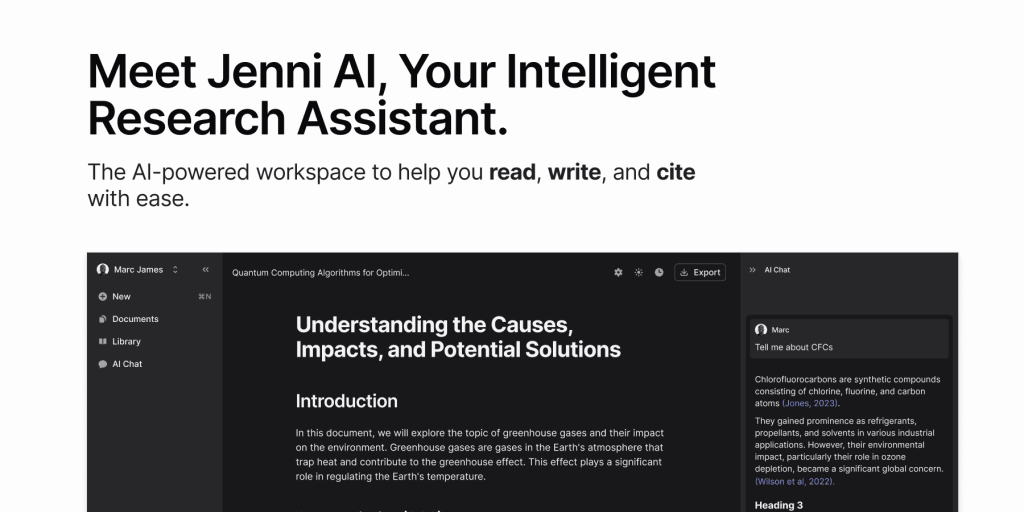
Jenni AI makes the most sense when we judge it as a research-writing assistant, not as another broad AI writer. On April 14, 2026, the official site positioned Jenni AI around writing, citing, editing, agentic chat, file-grounded generation, traceable citations, and practical workflow support for millions of writers. That matters because academic writers and serious long-form users often do not need the flashiest chatbot. They need help staying in flow while keeping citations, sources, and drafts manageable.

The Write, cite, and edit positioning is one of the clearest reasons Jenni AI can be useful. Instead of separating drafting, citation work, and revision into different tools, the official site presents these as one connected workflow. That is especially relevant for users who lose time bouncing between a writing app, a citation manager, and a general chatbot.

The in-text citation feature is one of Jenni AI’s most practical public signals. Citation handling is not a side feature in academic writing; it is part of the writing itself. Publicly highlighting in-text citations makes Jenni AI more relevant for students and researchers than AI tools that only help generate fluent paragraphs but leave citation work messy and disconnected.

AI autocomplete is another useful signal, but it needs to be interpreted carefully. Good autocomplete can help a writer maintain momentum, especially when the structure is already clear. The risk is that users may accept smooth wording too quickly. Jenni AI looks strongest here when the user already knows the argument and uses autocomplete for drafting speed rather than intellectual substitution.

The Agentic AI Chat section suggests Jenni AI is trying to support more iterative research work than sentence-level editing alone. This matters because many research writing problems involve back-and-forth clarification, source questions, and idea development. Used well, this can make Jenni AI more useful than a static editor that only rewrites text after the fact.

The file-grounded generation feature is another strong practical detail. Real academic work rarely begins from nothing. It often starts from papers, notes, transcripts, or old drafts. Publicly highlighting Generate From Your Files makes Jenni AI more convincing for users who want writing assistance grounded in their own material rather than in purely open-ended prompts.

The phrase Traceable citations, every time is one of the most important trust signals on the homepage. In research writing, it is not enough for a tool to sound confident. Users need to see where claims are anchored. This makes Jenni AI more promising for serious academic use than assistants that generate plausible text without keeping source relationships visible.

The pricing page also helps keep the evaluation grounded. Writing assistants can feel lightweight until a user depends on them for repeated drafting, editing, and source-heavy work. Public pricing details help users decide whether Jenni AI fits occasional academic help, frequent writing support, or a more continuous professional workflow.

Our grounded judgment is that Jenni AI is most worth trying for students, researchers, and long-form writers who want help drafting with citations, working from source files, and keeping research writing momentum without fully giving up control. It is less suitable for users who only want a generic chatbot or who expect AI writing to replace actual source evaluation and academic responsibility. Jenni AI looks strongest when the real need is writing support that stays close to citations and source material.