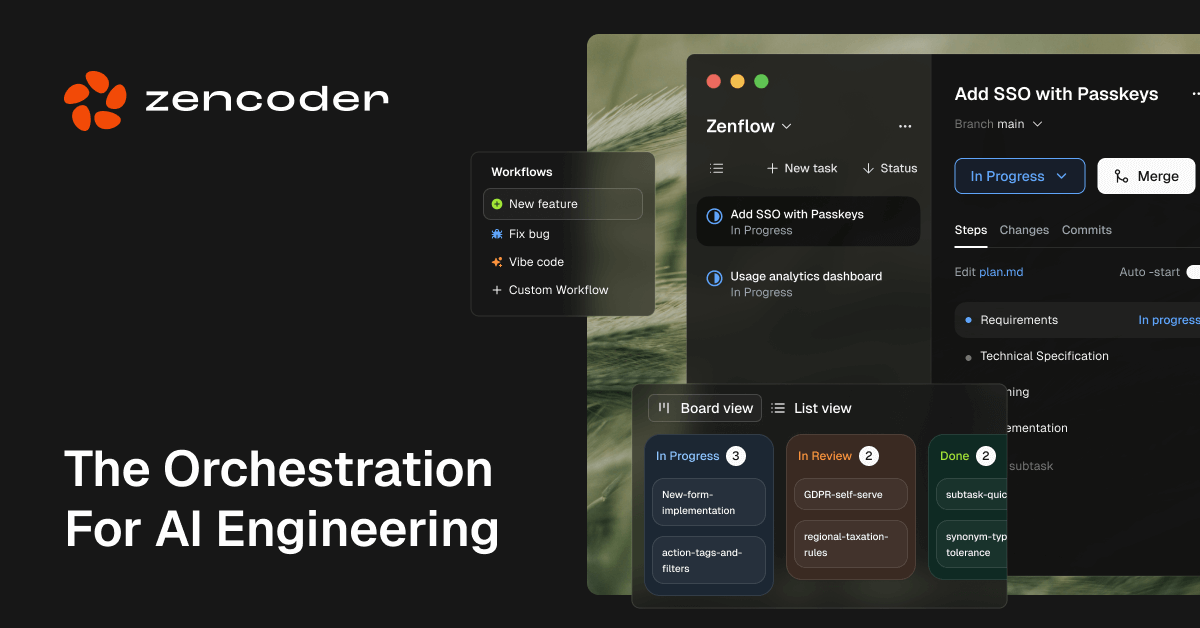
Zencoder
Category AI Coding
Published 2026-04-05

Overview

This section highlights the core features, use cases, and supporting notes.

Zencoder is an AI coding agent for developers who want task execution, code changes, and workflow acceleration rather than another passive chat window. It is most useful when the goal is to move a defined engineering task forward with less manual back-and-forth between planning, coding, and verification.

Zencoder is better understood as an execution-oriented coding agent than as a generic code assistant. Its appeal comes from helping developers push defined tasks forward, which matters most when teams already know what needs to be changed and want the AI to participate more actively in delivery.

It suits developers, technical founders, and product teams that regularly face repetitive implementation tasks, bug fixes, or well-scoped code changes. The fit becomes strongest when the workflow needs action and review, not just explanation.

What makes Zencoder worth attention is that task-level engineering work often stalls in the handoff between understanding and doing. An agent that can carry more of that middle section can save time if the user still reviews the output with discipline.

The tradeoff is that aggressive execution increases risk if teams stop checking the details. Code changes, dependencies, tests, and rollback paths still need human control. Faster output is only useful when the review loop stays strong.

This site recommends Zencoder for developers who want more than inline suggestions but are still prepared to inspect what the agent does. Start with one contained repository task, then keep it if the tool saves time without weakening code review standards.

Setup / Usage Guide

Installation steps, usage guidance, and common notes are maintained here.

  1. Open Zencoder from the official site and begin with one bounded engineering task. A bug fix, small feature, or refactor target is much better than an open-ended product request.
  2. Connect it to a code context you can safely review. Agentic coding only makes sense when the repository or task scope is clear enough for inspection afterward.
  3. Ask it to solve one problem that already has a measurable outcome. Passing tests, a fixed error, or a visible UI change makes evaluation much easier.
  4. Read the proposed changes before trusting the result. Execution speed is helpful only when the diff still makes architectural sense.
  5. Run the relevant checks and tests after every meaningful change. Agent-style tools should reduce labor, not reduce verification.
  6. Look for unintended side effects outside the exact target area. Fast helpers can still expand the change surface more than expected.
  7. Increase task size only after the first contained job is trustworthy. Bigger automation should follow smaller successful review loops.
  8. Keep Zencoder if it consistently advances real coding tasks while staying reviewable and reversible. That balance is the strongest reason to keep it.

Related Software

Keep exploring similar software and related tools.