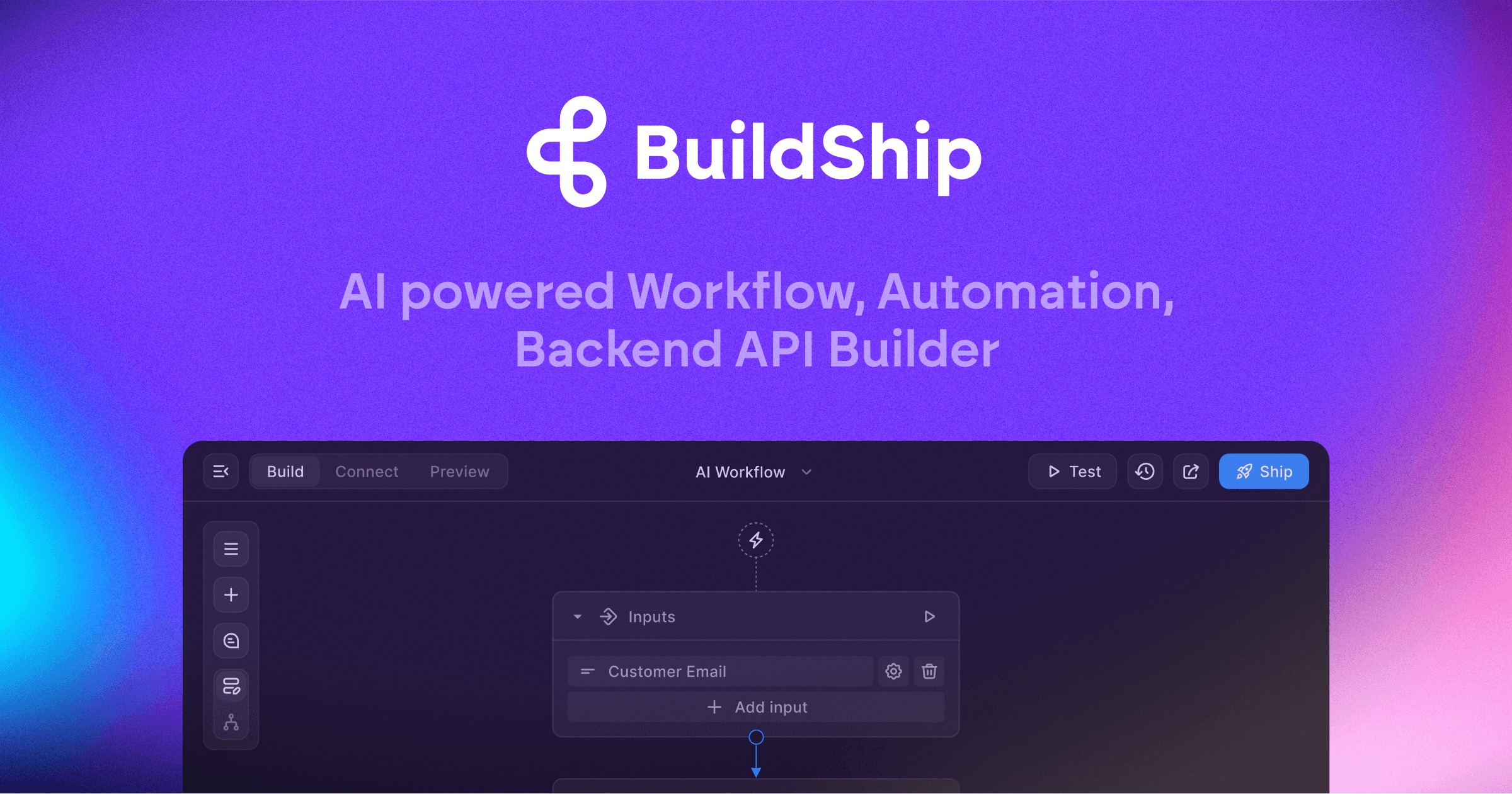
BuildShip
Category AI Coding
Published 2026-04-05

Overview

This section highlights the core features, use cases, and supporting notes.

BuildShip is an AI workflow builder for teams that want to create backend automations, agent tools, and API-connected flows with a visual-first approach and code access when needed. It is most useful when the problem is stitching models, services, and logic together into something testable without standing up a full backend from zero.

BuildShip focuses on the layer between an idea and a working service flow. Instead of asking teams to hand-build every backend process first, it offers a more direct way to connect AI steps, tools, APIs, and automation logic into a functioning workflow.

It suits product teams, developers, operators, and founders who need to prototype or run backend automations quickly. The fit is strongest when the goal is workflow delivery, tool wiring, or AI-service orchestration rather than conventional application coding alone.

What makes BuildShip worth attention is that AI products often stall in backend assembly. A platform that reduces the friction of connecting models, data, actions, and APIs can speed up testing and shorten the path to a usable internal or external workflow.

The tradeoff is that easier building can hide operational complexity. Permissions, retries, observability, data handling, and long-term maintainability still matter. Visual speed is helpful only if the resulting workflow is understandable and supportable later.

This site recommends BuildShip for teams that want to validate workflow ideas without spending the entire first phase on backend scaffolding. Start with one practical automation and keep it if the platform reduces wiring effort without making the logic harder to trust.

Setup / Usage Guide

Installation steps, usage guidance, and common notes are maintained here.

  1. Open BuildShip from the official site and define one workflow outcome before building anything. Good examples include processing input, calling a model, and returning a structured result.
  2. Start with the smallest version of the workflow that can still prove value. Early success matters more than showing every possible node in one diagram.
  3. Connect only the APIs and tools that the first use case truly needs. Minimal scope makes it easier to see whether the platform is helping or merely adding another layer.
  4. Test with realistic input payloads instead of toy examples. Real edge cases show how solid the workflow actually is.
  5. Review logs, retries, and failure behavior early. Workflow platforms are judged by what happens when a step breaks, not only when the happy path succeeds.
  6. Check how much code access or customization is needed before scaling the flow. That tells you whether the platform fits your team's actual technical style.
  7. Estimate running cost and external dependency load before wider rollout. Fast automation should still stay operationally sane.
  8. Keep BuildShip if it reliably shortens the path from workflow idea to maintainable automation. That is the practical standard that matters.

Related Software

Keep exploring similar software and related tools.