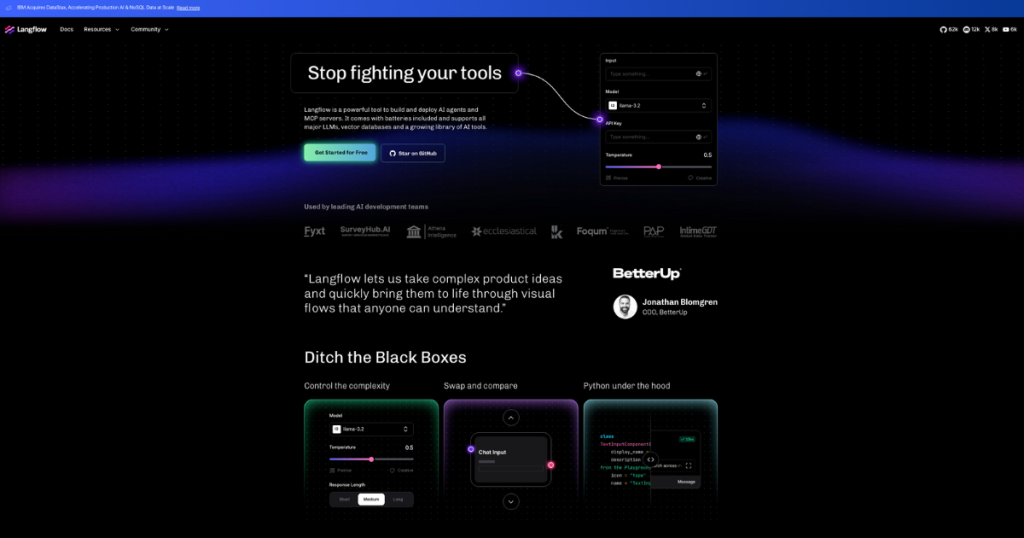
Langflow is best understood as a low-code workflow builder for agentic and RAG applications, not as a finished end-user AI product. On April 14, 2026, the official site at langflow.org publicly positioned the platform around a visual builder, reusable templates, and deployment-minded workflows. That framing matters because many teams do not need another chatbot demo; they need a way to assemble, test, and evolve flows with less friction than a fully code-first stack.

The homepage sections are practical because they speak directly to build friction. Create your first flow, From Notebook to Production, and Drag. Drop. Deploy. all point to the same real promise: reducing the distance between experimentation and something that can actually be tested, shared, and shipped. That makes Langflow relevant for users searching terms like low-code AI builder, visual RAG workflow builder, or drag-and-drop agent pipeline tool.


The public Use Cases page adds real decision value because it exposes templates instead of vague promises. Public entries such as call classification analytics, CSV query assistant, data extraction, PRD draftsman, bug report deduplicator, and contract risk scanning show that Langflow is not only for one narrow chatbot scenario. It is more useful when the team already has a business or operations problem in mind and wants a fast way to adapt an existing pattern.

The documentation is another strong signal. The docs homepage explains what Langflow is, while the installation guide exposes several routes: desktop, Docker, and the OSS Python package. That matters because Langflow is not a single-path SaaS product. Some users want a local desktop start, some want Docker, and some want to work closer to the open-source package. A good Langflow page should set that expectation clearly.


The desktop page is especially practical for users who want to try Langflow without setting up a full self-hosted stack on day one. Since the official homepage Get Started for Free path pointed to the desktop route during this run, it is reasonable to treat desktop as the clearest public first-use entry. Our grounded judgment is that Langflow is most worth trying for builders, product teams, and internal platform teams who want visual AI workflow assembly plus reusable templates. It is less suitable for users who only want a ready-made chatbot or who expect low-code tooling to remove the need for architecture and evaluation decisions.