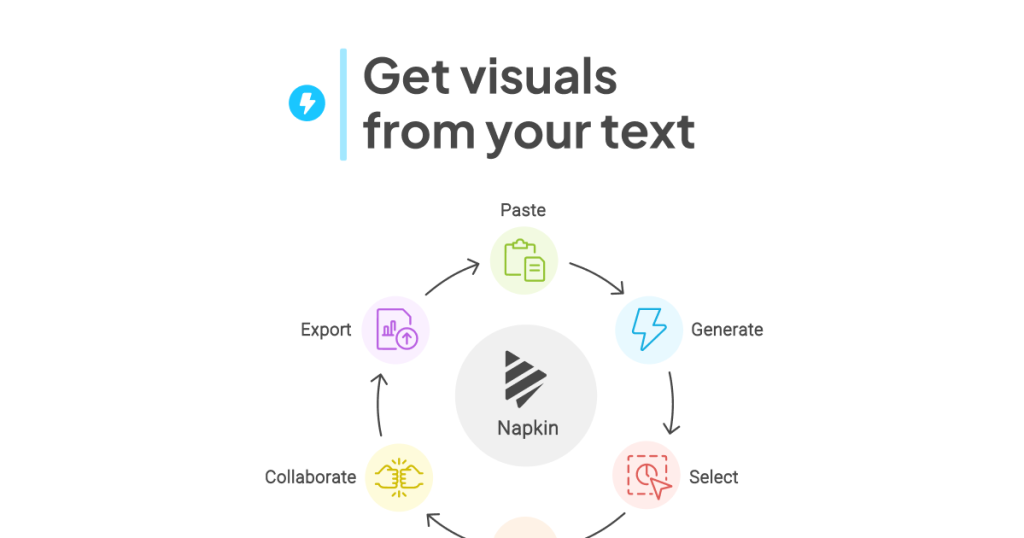
The current English page for Napkin is still too thin for what Napkin’s own materials now show. The official homepage checked on April 19, 2026 presents Napkin as The visual AI for business storytelling, and its main headline says users can Get visuals from your text. That matters because Napkin should not be judged like a generic AI image generator or a traditional desktop design program. It is being positioned as a text-to-visual communication tool.

The official Pricing page reinforces that Napkin expects ongoing use rather than one-off curiosity. The page headline says Create Compelling Visuals 10x Faster. Even without adopting that claim uncritically, the important point is that Napkin is being sold as a speed layer for regular communication work. That fits teams and individuals who repeatedly need visuals for ideas, documents, presentations, and internal storytelling rather than occasional decorative output.

The App sign-in page is one of the clearest practical signals about how Napkin should be approached. The homepage links directly to https://app.napkin.ai/signin, and the site says users can get started instantly with no download required. That matters because Napkin is primarily a browser-first tool. Users expecting a classic Windows installer will misunderstand the product from the beginning.

The official Getting Started collection supports that same interpretation. Its description says it contains everything users need to know to get started. That matters because tools that convert text into visuals often feel easy in demos but still need some guidance in real use. A visible onboarding collection reduces the gap between the marketing promise and the first workable result.

The Features collection is equally important because visual business-storytelling tools live or die on what users can actually do after the first wow moment. Napkin’s help center says users can explore all the capabilities that Napkin AI offers. That matters because a communication tool should be judged by usable feature depth, not only by the emotional pull of a homepage headline.

The official Languages collection gives another practical fit signal. It says users can learn about supported languages. That matters because a tool that turns text into visuals becomes much less useful if language support is vague or if users only discover language limits after they have already started building materials for real work.

The Login & Account collection may sound routine, but it matters a lot for browser-first software. The help center says this area covers logging in and managing the account. That matters because access friction can quickly kill adoption even when the core product idea is strong. Napkin looks more trustworthy when account support is explicit and maintained.

The Subscription & Billing collection also matters because Napkin is clearly a continuing-service product rather than a one-time install. Its description says it supports upgrading, billing, and plans. That matters because users only keep this kind of tool when plan questions, upgrades, and billing issues have a clear official support route.

The Frequently Asked Questions collection gives one more useful trust signal. It promises common questions and quick answers. That matters because everyday confidence often depends on whether normal user doubts can be resolved without opening a support ticket every time. A business-communication tool should help users move quickly, and visible FAQ support is part of that speed story.

The Privacy Policy is the final piece that keeps the recommendation grounded. Napkin handles user text, ideas, and communication material that may be sensitive enough to deserve visible policy review. A browser-based AI tool should not be judged only on how fast it creates visuals. It should also be judged on whether its trust and policy surfaces are easy to find.

Our grounded judgment is that Napkin is strongest for users who regularly need to turn written ideas into visual material for presentations, internal communication, or business storytelling without opening a heavier design workflow. It is a weaker fit for users who want a fully offline desktop graphics program, highly detailed illustration control, or a general-purpose image-generation sandbox. Napkin looks most defensible when the real problem is clarifying ideas visually from text, not doing full custom design from scratch.