Overview

This section highlights the core features, use cases, and supporting notes.

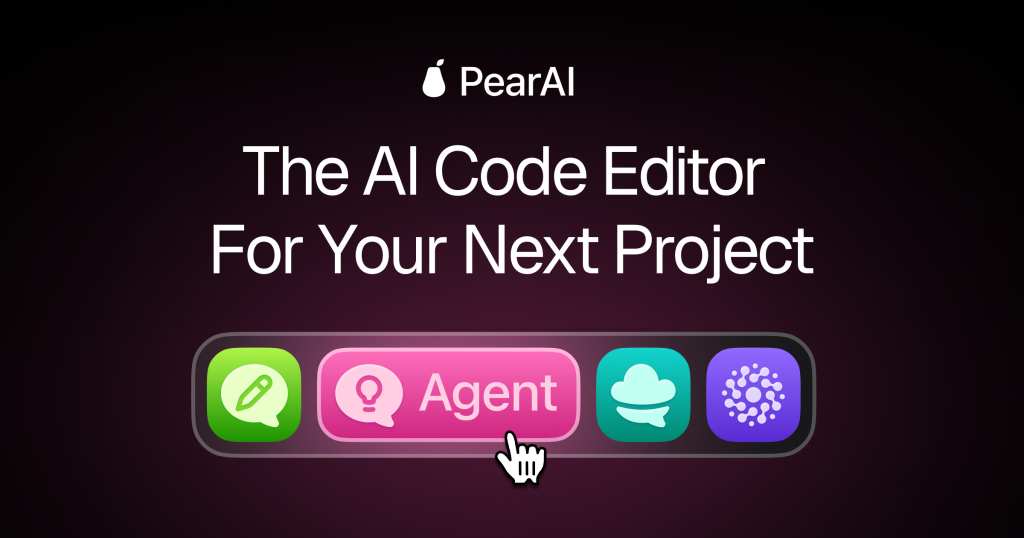
PearAI is best understood as an open-source AI code editor aimed at helping users build and ship real projects rather than as a narrow chat extension. The official materials checked on April 16, 2026 show a broader product surface: a project-building editor with PearAI Router for model selection, a coding agent powered by Roo Code or Cline, Mem0-based memory, aider-based Creator automation, configurable autocomplete, a public beta channel, and an open GitHub repository that describes PearAI as a VSCode fork with local code storage and a familiar feel. The current official changelog and GitHub release data also show stable and beta release tracks, so PearAI fits developers who want a more guided AI-first editor workflow without giving up the comfort of a VSCode-like environment.

The current English page for PearAI is still too thin for what the official materials now show. The official site checked on April 16, 2026 positions PearAI as the AI code editor for your next project, not only as another generic AI chat tool. That matters because the homepage frames PearAI around project creation, codebase context, model routing, coding help, login flows, and even launching web projects rather than around one isolated coding panel.

Annotated reference image based on the official PearAI homepage showing project building model routing coding help login support and web project launch positioning
The official site matters because PearAI is framed as a project-building environment rather than only as a chat layer inside an editor.

The about page repeats that practical direction more clearly. PearAI says it is an AI code editor with a suite of tools to help users build what they want, and it explicitly says the goal is not just prototyping but supporting a longer lifespan of added features and growth. That is a useful distinction because many AI editor pages only optimize for a first wow moment, while PearAI is trying to present itself as something users keep for actual project work.

Annotated reference image based on the official PearAI about page showing a suite of AI tools for building projects beyond simple prototyping
The about page matters because it shows PearAI trying to be a fuller project workflow, not only a quick demo editor.

The beta page also adds decision value because it shows PearAI still maintaining a preview track. The official page is titled Download PearAI Beta Version and explicitly asks users to try the latest beta and give feedback in Discord. That tells readers PearAI is still evolving actively enough that some features are meant to be tried on a faster channel than the normal install flow.

Annotated reference image based on the official PearAI beta page showing a dedicated beta download channel with Discord feedback flow
The beta page matters because it shows PearAI still expecting users to test newer builds and give product feedback, not only install once and forget it.

The official changelog provides a more grounded view of what that evolution actually looks like. The visible entries include v1.8.6 updating RooCode to v3.10.2, v1.8.0 introducing PearAI Coding Agent and a new product focus, earlier Mem0-based memory additions, Relace-powered Fast Apply, and overlay or extension UI overhaul work. This is much stronger than a generic claim that the editor is improving.

Annotated reference image based on the official PearAI changelog showing v1.8.6 v1.8.0 coding agent memory fast apply and UI updates
The changelog matters because it shows PearAI’s feature surface evolving through real releases, not only through homepage claims.

The coding-agent announcement is one of the most useful official pages for judging current fit. PearAI says the Coding Agent in v1.8 is powered by Roo Code or Cline and can directly interact with the development environment with your explicit permission. That phrasing matters because it sets a more realistic expectation than a page that only says the tool is smart. PearAI is trying to automate coding work more actively, but it is also acknowledging that environment access should be deliberate.

Annotated reference image based on the official PearAI coding agent post showing Roo Code or Cline powered coding with explicit environment permission
The coding-agent post matters because it shows PearAI moving beyond chat into a more active coding workflow, while still calling out permission and environment access.

The memory announcement gives PearAI a stronger continuity story. The official post says PearAI Memory adds a memory layer to PearAI Chat, can remember coding preferences and codebase settings across sessions, and is powered by Mem0. For users who get tired of re-explaining the same project context, this is one of the clearer reasons PearAI may be worth keeping around instead of trying only once.

Annotated reference image based on the official PearAI memory beta post showing Mem0 powered memory for coding preferences and codebase settings across sessions
The memory post matters because it shows PearAI trying to reduce repeated setup and repeated prompting instead of treating every session as brand new.

The Creator beta post extends that automation angle further. PearAI says Creator is powered by aider, can build apps, fix bugs, and implement features automatically, and has full codebase context with the ability to create and edit multiple files. That is a strong practical claim because it pushes PearAI beyond assistant-style suggestion and closer to a project operator inside the editor.

Annotated reference image based on the official PearAI creator beta post showing aider powered app building bug fixing and multi file editing with codebase context
The creator beta post matters because it shows PearAI offering more than guidance; it is also trying to automate project changes directly.

PearAI is not only about the heaviest automation features, though. The autocomplete guide shows that the editor still supports a lighter day-to-day layer through tab autocomplete. The official guide recommends Codestral for completion and explains how to configure it in config.json. That matters because many users need ordinary completion help more often than they need a full build-or-fix workflow.

Annotated reference image based on the official PearAI autocomplete guide showing tab autocomplete setup with Codestral and config json
The autocomplete guide matters because it shows PearAI still supporting ordinary coding speed improvements, not only bigger automation features.

The public GitHub repository is also one of PearAI’s strongest trust signals. The README calls PearAI the open-source AI-powered code editor, says it is a fork of VSCode, notes that the main functionality lives in a PearAI submodule that is a fork of Continue, and explicitly says code is stored locally on your computer. That public description helps separate PearAI from closed AI editor pages that ask users to trust vague claims without showing the underlying base.

Annotated reference image based on the official PearAI GitHub repository showing open source positioning VSCode fork local code storage and familiar feel
The GitHub repo matters because it grounds PearAI’s open-source and local-context claims in a public repository instead of only in site copy.

A current release check matters too. The GitHub API checked on April 16, 2026 reported the latest stable release as PearAI v1.8.9 - Linux, published on May 2, 2025, while the same release list also showed a newer prerelease track, PearAI v2.0.0 Beta - Linux, published on May 16, 2025. Even if PearAI’s public site leans heavily on product copy, the release data still shows stable and beta packaging tracks that users can actually monitor.

Annotated reference image based on the official PearAI release data showing stable v1.8.9 and beta v2.0.0 packaging tracks on GitHub
The release check matters because it confirms PearAI is still maintaining stable and beta release channels, not only leaving old builds online.

Our grounded judgment is that PearAI is most worth installing for developers who want an AI-first editor with a familiar VSCode-like feel, open-source visibility, local code storage, a few different automation layers, and enough built-in guidance to move from idea to project faster. It is a weaker fit for users who only want the lightest inline completion tool, who do not want to manage optional model setup or beta features, or who prefer a simpler assistant that stays outside the editor instead of becoming part of the editor workflow itself.
Setup / Usage Guide

Installation steps, usage guidance, and common notes are maintained here.

The best way to evaluate PearAI is to treat it as an AI-first editor workflow rather than only as another chat tool. The official materials checked on April 16, 2026 show a VSCode-based open-source editor with model routing, coding-agent automation, memory, Creator beta, autocomplete configuration, and both stable and beta release tracks.

  1. Start from the official website at https://trypear.ai/ so you see the current project-building positioning before downloading anything.
  2. Use the official download entry at https://trypear.ai/download. PearAI also exposes a dedicated beta page, so decide early whether you want the regular channel or the faster-moving beta track.
  3. If you are evaluating PearAI for real work, open an existing repository instead of a blank editor. PearAI repeatedly emphasizes codebase context, so a real project is the only meaningful way to judge it.
  4. Use the ordinary chat or ask flow first before enabling heavier automation. This gives you a baseline for whether PearAI understands your codebase and editor workflow in a helpful way.
  5. Once basic context looks reasonable, try the Coding Agent. The official coding-agent post says it can interact with the development environment with your explicit permission, so start on a bounded bug fix or feature rather than a large, risky task.
  6. If you want stronger automation, test PearAI Creator next. The official Creator beta post says it can build apps, fix bugs, and edit multiple files with full codebase context, but because it is still beta, it is better to start with reversible work.
  7. Turn on PearAI Memory only after the base editor behavior already makes sense to you. The official Memory beta post says it remembers coding preferences and codebase settings across sessions, which is useful only if you plan to keep using PearAI long enough for that memory to matter.
  8. If day-to-day typing speed matters more than bigger automation, configure tab autocomplete. PearAI's own guide recommends Codestral and walks through config.json setup, which gives you a lighter editing layer even when you do not want Creator or the Coding Agent.
  9. Check the GitHub repository before you commit to PearAI as a long-term editor. The official README explains that PearAI is a fork of VSCode, that the main functionality lives in a related submodule, and that code is stored locally on your computer.
  10. If you want the newest features, compare the beta page with the stable release track before updating. PearAI exposes both stable and beta channels, so do not assume the newest preview is the safest daily-driver choice.
  11. Before trusting PearAI on important work, read the official changelog. The visible entries show coding-agent rollout, memory, Fast Apply, and recent maintenance work, which helps you understand what the editor has actually been changing.
  12. Keep your first serious task small enough to inspect manually. PearAI is strongest when it can help you move faster through a project, but the heavier agent features still need human review if the task affects multiple files or project structure.
  13. If PearAI fits your workflow, decide whether you want to stay on the familiar VSCode-like editor base with built-in AI layers, or whether a simpler companion tool outside the editor would actually be easier to maintain.

A practical PearAI setup usually means downloading from the official entry, opening a real repository, testing ordinary codebase-aware chat first, trying Coding Agent on one bounded task, adding Memory or Creator only after the basics feel trustworthy, then deciding whether the stable or beta channel better matches how much product change you actually want in your daily editor.

Related Software

Keep exploring similar software and related tools.