Pieces
Category AI Coding
Published 2026-04-05

Overview

This section highlights the core features, use cases, and supporting notes.

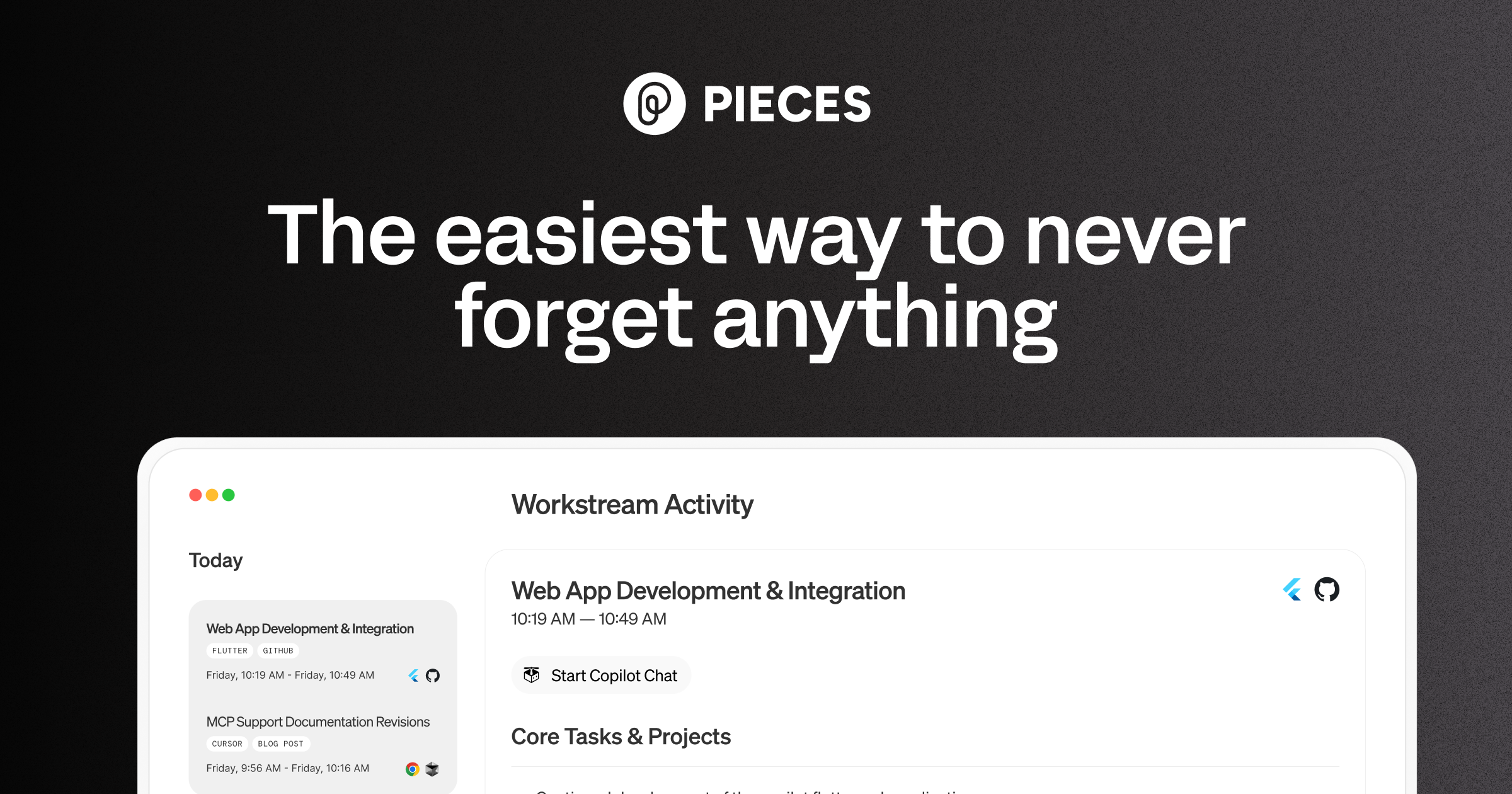
Pieces is an AI memory and productivity companion for developers who want snippets, live context, and long-term work history to stay usable across IDEs, browsers, and collaboration tools. It is most useful when the real problem is not generating more code, but remembering what you already solved and why it mattered.

Pieces is best understood as a memory layer for digital work rather than a simple snippet box. Its value comes from capturing context from the places where developers actually work and making that history easier to revisit later.

It suits developers, technical writers, and knowledge-heavy builders who switch between tools, projects, and problem types often enough that important work patterns start disappearing into copy-paste history and scattered tabs.

What makes Pieces worth attention is that repeated work is often a memory problem, not a capability problem. A tool that helps users recover useful snippets, prior solutions, and relevant context can save more time than another assistant that only answers from scratch.

The tradeoff is that memory tools need stronger judgment around privacy and signal quality. Capturing more context is only helpful if users remain comfortable with what is stored and if retrieval stays relevant rather than noisy.

This site recommends Pieces for developers who want to build a more durable personal work memory without turning the process into manual note-taking. Start with one normal week of work, then keep it if the recovered context consistently saves time and mental effort.

Setup / Usage Guide

Installation steps, usage guidance, and common notes are maintained here.

  1. Open Pieces from the official site and install it in the tools where you already work. A memory tool should be judged in your real workflow, not in a staged demo.
  2. Let it capture a few real tasks before trying to search everything immediately. Useful memory needs actual context to build from.
  3. Save or review one genuinely reusable snippet or solution first. The product value becomes clear when you can recover something worth keeping.
  4. Try retrieving a past answer during a new task instead of only browsing the interface. That is the practical moment Pieces is meant to improve.
  5. Check what is being stored and whether it matches your privacy comfort level. Strong memory is only valuable when the data boundary still feels acceptable.
  6. Compare whether it helps more with code, browser research, or collaboration context. The strongest part of the workflow may vary by user.
  7. Prune or ignore low-value noise early. Memory systems work best when the useful signal stays easier to find than the raw history.
  8. Keep Pieces if it turns past work into retrievable, time-saving context instead of another archive you never revisit. That is the strongest reason to keep it.

Related Software

Keep exploring similar software and related tools.