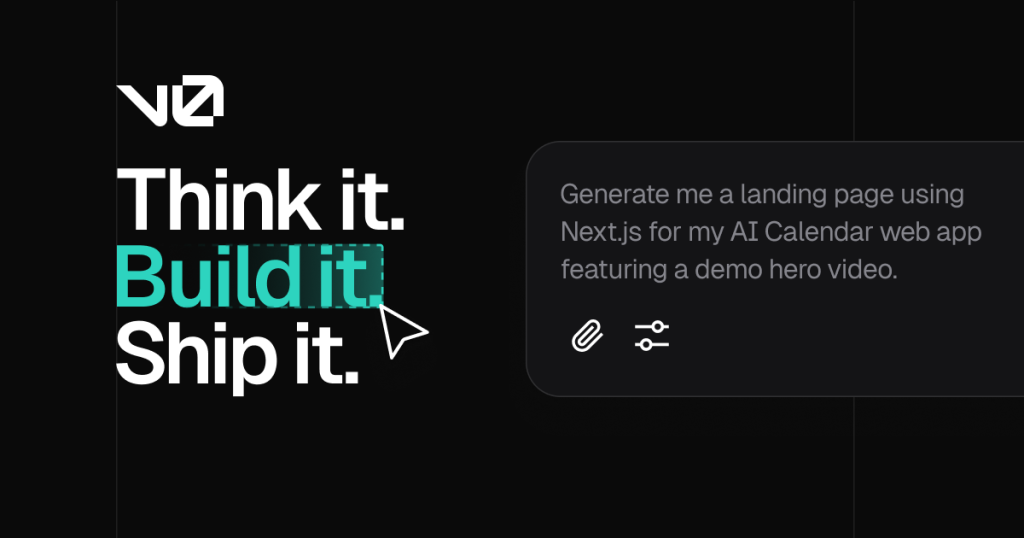
v0 is best understood as an AI app builder and coding workflow surface rather than just an AI website generator. The official homepage and introduction docs both push the same message: v0 helps people create real code, full-stack apps, and even agents, not only pretty static screens. That distinction matters because a lot of AI UI tools look impressive in demos but stop being useful once you need backend logic, deployment, GitHub workflows, or iterative changes that go beyond surface-level mockups.

The official home page is also unusually clear about the workflow around the tool. On April 13, 2026, the page explicitly highlighted capabilities like Sync with a repo, Integrate with apps, Deploy to Vercel, Edit with design mode, and Start with templates. It also promoted an iOS app. That is useful because v0 is not strongest when treated like a one-shot text box. It is strongest when used as a loop: prompt, inspect, edit, integrate, publish, and keep iterating.
The pricing page adds important reality to that workflow. When checked on April 13, 2026, the official pricing page showed a Free plan at $0/month with $5 of included monthly credits, Deploy apps to Vercel, Edit visually with Design Mode, Sync with GitHub, and a 7 message/day limit. The same page listed Team at $30/user/month, Business at $100/user/month, and Enterprise with custom pricing. It also showed that Team and Business include $30 of included monthly credits per user and $2 of free daily credits on login per user, while Business adds training opt-out by default and Enterprise adds your data is never used for training, SAML SSO, and role-based access control. That matters because v0 is easy to overuse without understanding how credits, collaboration, and privacy boundaries change by plan.

The introduction docs are one of the best official sources for deciding whether v0 fits your role. The docs say v0 is an AI agent that helps anyone create real code and full-stack apps and agents, and they outline use cases for product managers, designers, engineers, data scientists, marketing teams, educators, support teams, and founders. That is helpful because v0 is not only for frontend engineers. It is also designed for people who need prototypes, interactive specs, forms, dashboards, landing pages, or MVPs without hand-coding every first draft. The tradeoff is that useful output still depends on judgment. v0 can accelerate a team, but it does not remove the need to understand requirements and review generated code carefully.

Prompt quality is one of the biggest practical differences between good and disappointing v0 sessions, and the official text prompting docs say that directly. The page recommends starting simple, planning the project, providing context, specifying technical preferences, and breaking down complex tasks into smaller iterations. It also documents voice input for signed-in users and explains that v0 may offer prompt enhancement when a request is too vague. This is useful because many users waste credits by asking for a full product in one giant prompt. v0 tends to work better when the request is scoped, technical context is explicit, and iteration is treated as normal rather than as failure.

Screenshots and files are another major part of what makes v0 practical. The official docs say you can upload or drag files into chat, and that if the file is a screenshot, v0 analyzes the layout, colors, and components in the image and generates code to replicate the interface. The same page recommends high-resolution screenshots, clear crop choices, and extra instructions, and it notes that v0 defaults to shadcn/ui components and works best with Next.js and Tailwind CSS. That matters because many real projects begin from screenshots, wireframes, or partial reference designs rather than from pure text. v0 becomes much more useful when you let it see what you mean.

Design Mode is one of the clearest reasons to keep using v0 after the first generation. The official docs explain that you can enable Design Mode, select elements visually, and then either prompt for more complex changes or use a design panel for fine-grained adjustments. The same page says the design panel can change typography, color, background, layout, borders, opacity, shadows, and content, and that these visual tweaks do not consume v0 tokens. That is very practical. It means not every small visual refinement needs to go back through a text generation loop, which makes v0 feel more like a working design-and-code surface than a disposable prompt toy.

Deployments are where v0 either becomes a real tool or stays a demo. The official deployment docs say you can publish a chat to production on Vercel in a few clicks, get a production URL, and benefit from features such as global CDN distribution, automatic HTTPS, edge caching, performance monitoring, and analytics integration. The same page also explains the Built with v0 badge, which is on by default for free users and can be disabled by paid users, and mentions a Fix with v0 path for deployment errors with up to 20 free uses per day on unedited code. That matters because shipping is not only about generating UI. v0 becomes much more compelling when the path from chat to live preview is short and predictable.

GitHub integration is another practical boundary between experimentation and maintainable work. The official GitHub docs say that when a chat is connected to GitHub, the repository becomes the source of truth. v0 automatically creates a branch off main, auto-commits every code-changing message, and guides users toward pull requests rather than pushing straight to production code. The docs also explain that team members normally need GitHub repository access to collaborate, unless the workspace enables Allow v0 to Act on Behalf of Members. This matters because v0 works best when its speed is connected to normal engineering hygiene instead of bypassing it.

Our grounded judgment is that v0 is most worth using when you need to go from idea to working code quickly and you are prepared to review, scope, and refine the output like a real project. It is especially practical for prototypes, landing pages, internal tools, MVPs, and interface-heavy full-stack work that benefits from screenshots, rapid iteration, GitHub sync, and Vercel deployment. It is less suitable if you expect one vague prompt to replace planning, architecture decisions, or code review. v0 is strongest as an accelerator inside a serious workflow, not as magic that removes the workflow.