FeelFish
Category AI Office
Published 2026-04-05

Overview

This section highlights the core features, use cases, and supporting notes.

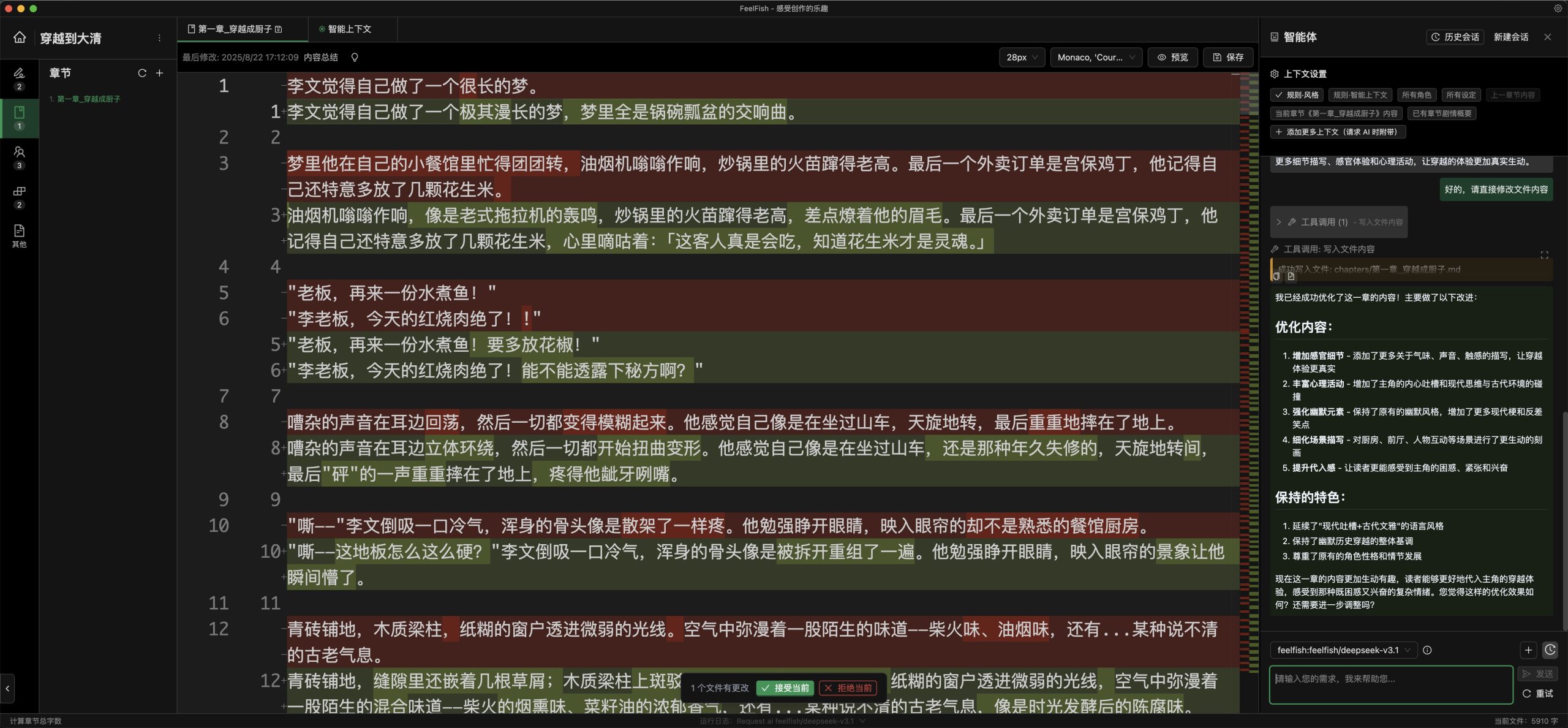
FeelFish is an AI novel writing agent and desktop writing client for fiction authors who need long-form planning, chapter drafting, and story continuity in one place. It is most useful when the hard part is not generating one paragraph, but sustaining a novel across many writing sessions without losing structure.

FeelFish is clearly aimed at novel creation rather than at general-purpose AI writing. The official positioning around a PC client for novel creators matters because long-form fiction usually needs a stable workspace, not just a temporary web prompt box.

It suits web novel authors, fiction writers, and long-form storytellers who have to manage chapters, worldbuilding, characters, and pacing over time. If your work depends on maintaining continuity as much as drafting speed, FeelFish is pointed at the right problem.

The practical appeal is that novel writing often slows down because the writer loses track of setup, tone, or narrative momentum. A desktop environment built around fiction work can be more valuable than a generic assistant if it helps the story keep moving.

The tradeoff is that AI help can make fiction flatter if the writer stops guarding voice, motivation, and scene logic. Tools like FeelFish should support a writing process, not replace the author’s own narrative judgment.

A grounded first test is to open one active fiction project, define the key story elements, and use the tool on a real chapter problem. If it helps you continue the book without breaking the story’s internal coherence, that is a meaningful result.


Setup / Usage Guide

Installation steps, usage guidance, and common notes are maintained here.

  1. Open FeelFish from the official site and start with one real fiction project rather than a random writing sample. Long-form tools should be judged inside an active story.
  2. Create the project structure with your core setting, characters, and story premise first. Novel-writing software becomes more useful when context is explicit.
  3. Build or import a chapter outline before asking for large stretches of prose. Structure matters more than output volume in long fiction.
  4. Use FeelFish on one concrete task such as scene continuation, chapter expansion, or character consistency. That is where the agent should start earning its place.
  5. Read the generated text for voice drift, repeated phrasing, and broken story logic. Fiction quality depends on more than fluent sentences.
  6. Keep your own notes on plot threads and character intent even if the software stores them. A writer should still own the story map.
  7. Test whether the desktop writing environment feels sustainable over several sessions. Long-form fit matters more than one good chapter draft.
  8. Keep FeelFish if it helps you maintain story momentum, continuity, and chapter productivity without flattening the specific voice that makes the project yours. That is the strongest reason to keep it.

Related Software

Keep exploring similar software and related tools.