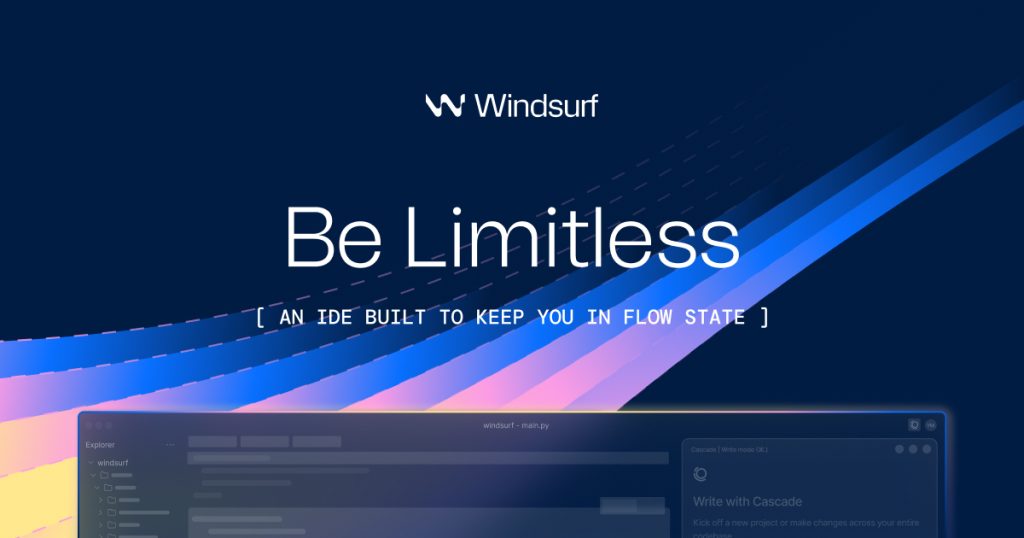
The current English page for Windsurf is still too thin for what the official materials now show. The official site checked on April 16, 2026 positions Windsurf as an AI coding experience built to keep developers and teams in flow. That matters because Windsurf is not being sold only as a better completion box. The same product surface also highlights remembered codebase context, lint fixes, MCP tools, image input, and terminal continuity.

The official getting-started docs describe a real editor onboarding path instead of only a download button. Windsurf documents installation for Mac, Windows, and Linux, then walks users through importing VS Code or Cursor settings, choosing a theme, signing in, opening a folder or remote server, and checking for updates. That tells users Windsurf expects to become a working editor environment, not just a short-lived demo.

The Cascade docs are the clearest explanation of Windsurf’s main value. Windsurf describes Cascade as its agentic assistant with Code and Chat modes, tool calling, voice input, named checkpoints, real-time awareness, and linter integration. That is a much broader operating surface than a standard code-completion extension.

Windsurf becomes more convincing when you look at how it tries to retain project context. The official memories docs say users can persist context across Cascade conversations through auto-generated memories and user-defined rules. Those rules can live in .windsurf/rules in the workspace, sub-directories, or parent directories up to the git root, and enterprise teams can also use system-level rules.

The MCP integration docs extend that argument further. Windsurf documents connecting Cascade to custom tools such as GitHub, databases, and APIs through stdio, HTTP, and SSE transports. It also documents custom registries plus admin controls for team environments. That matters because real development work rarely lives entirely inside the editor.

The terminal docs show that Windsurf treats shell work as part of the editor workflow rather than as something the user must manage separately. Windsurf documents an enhanced terminal with Command mode, Cascade integration, Turbo mode, auto-execution levels, and allow or deny lists. This makes Windsurf especially relevant for developers who want agent help to stay close to real commands.

Windsurf is also not only about heavy agent sessions. The Tab overview shows that the editor still provides lighter AI help through inline suggestions, Tab to Jump, and Tab to Import. That is important because many users need fast editing assistance more often than they need a full multi-step agent run.

The workflows docs show one of Windsurf’s more durable advantages. Users can create reusable Cascade workflows as markdown files in .windsurf/workflows to automate repetitive tasks such as deployments, pull-request reviews, and code formatting. This is a better long-term story than pasting the same instructions into chat again and again.

Enterprise fit is easier to understand from the remote-indexing docs than from marketing language alone. Windsurf documents indexing remote repositories from GitHub, GitLab, and BitBucket for enterprise teams without storing code locally. That is a more concrete statement about context awareness under infrastructure constraints.

A current changelog check is still necessary for any AI editor recommendation. On April 16, 2026, the top visible Windsurf changelog entry was version 2.0.44, published on April 15, 2026. That current entry highlights Devin cloud agent access inside Windsurf, delegation from a local session to a VM, task-level Spaces, a refined Windsurf Browser, and stability work for WSL, SSH, and Dev Containers.

Our grounded judgment is that Windsurf is most worth installing for developers and teams who want one editor surface that combines agent help, terminal cooperation, inline suggestions, retained project rules, reusable workflows, and external tool access through MCP. It is a weaker fit for users who only want the lightest possible completion layer or who do not want to manage editor migration, rules, workflows, or command-execution controls.